#129 – Why I Don’t Call it “Self-Management” Anymore – with Lisa Gill
BOUNDARYLESS CONVERSATIONS PODCAST - EPISODE 129
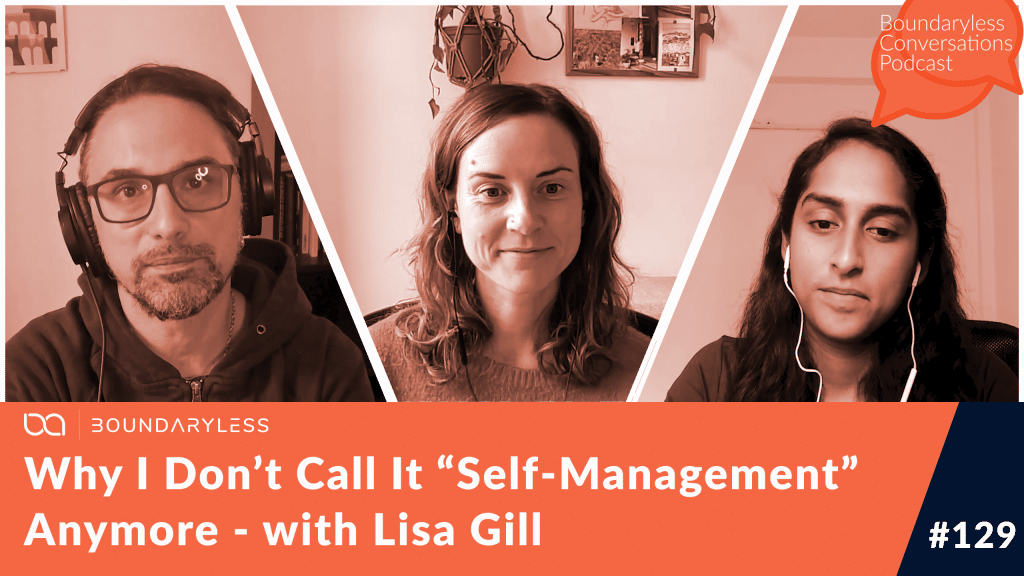
#129 – Why I Don’t Call it “Self-Management” Anymore – with Lisa Gill
Lisa Gill – a coach, facilitator, and host of the acclaimed Leadermorphosis podcast – joins us to explore the evolving world of self-managing organisations.
Drawing on over a decade of experience and examples from companies like Buurtzorg and her own work at TUFF Leadership, Lisa speaks about what makes radically decentralised organisations work: dynamic hierarchies, enabling structures, and accountability without coercion.
Drawing on lessons from allied fields such as social justice and disability justice, she emphasises that accountability is a relational practice rather than a top-down mechanism, and that true accountability requires choice, trust, and transparent communication.
This episode is packed with essential insights and practical nuggets that you can take back and reflect on, so don’t miss out.
Youtube video for this podcast is linked here.
Podcast Notes
In this episode, Lisa takes us deep into the realities of implementing self-management and radically decentralised organisations in practice.
Reflecting on the self-management movement’s trajectory, she discusses the concept of the “green trap” – a common organisational sticking point – and uses it to emphasise why psychological comfort without sufficient accountability is unsustainable.
She also covers several other core topics for the future of decentralised organisations – like the five organisational systems, the importance of inner shifts, what it means to create environments where people can sit in discomfort, learn, and grow without relying on coercion, and so much more.
Key highlights
👉 Self-managing organisations thrive on dynamic hierarchies, enabling structures, and distributed decision-making rather than rigid top-down control.
👉 Accountability works best as a relational practice grounded in choice, trust, and transparent communication, not coercion.
👉 True accountability requires freedom: individuals must be able to say no for their yes to be meaningful and fully owned.
👉 Balancing care and performance creates spaces for development where individuals and teams can grow sustainably.
👉 Psychological safety paired with challenge fosters both learning and innovation, avoiding the traps of comfort or anxiety extremes.
👉 Exposure to real consequences – like zero distance to customers – builds responsibility and encourages self-correcting behaviour.
👉 Both market performance and human-centred care can coexist when organisations prioritise autonomy, clarity, and alignment on values.
👉 Commitment-keeping and follow-through are foundational principles for self-managing, high-trust organisations.
This podcast is also available on Apple Podcasts, Spotify, Google Podcasts, Soundcloud and other podcast streaming platforms.
Topics (chapters):
00:00 Why I Don’t Call it “Self-Management” Anymore – INTRO
01:22 Introducing Lisa Gill
02:50 Introducing Self-Management
11:12 Radically decentralised organisations and the future of Collaboration
18:34 Operationalizing Decentralization in Self-Managing organisations
24:26 Learnings on Self-Reflection from Allied Industries
29:40 What’s the Future of Self-Management?
37:51 Enabling Ecosystemic Transformation
43:47 Breadcrumbs and Suggestions
To find out more about her work:
Other references and mentions:
- Frederic Laloux’s book – Reinventing Organisations
- Mike Lee and Amy Edmondson
- Perttu Salovaara
- Miki Kashtan
- Mia Mingus
- Adrienne Maree Brown’s book – Loving Corrections
- Amahra Spence
- Mind Era
- Robert Keegan
- Buurtzorg
- Citizens by John Alexander
- Rendanheyi
- 3EO Toolkit
Guest suggested breadcrumbs:
This podcast was recorded on 17 October 2025.
Get in touch with Boundaryless:
Find out more about the show and the research at Boundaryless at https://boundaryless.io/resources/podcast
Twitter: https://twitter.com/boundaryless_
Website: https://boundaryless.io/contacts
LinkedIn: https://www.linkedin.com/company/boundaryless-pdt-3eo
In this episode, Lisa takes us deep into the realities of implementing self-management and radically decentralised organisations in practice.
Reflecting on the self-management movement’s trajectory, she discusses the concept of the “green trap” – a common organisational sticking point – and uses it to emphasise why psychological comfort without sufficient accountability is unsustainable.
She also covers several other core topics for the future of decentralised organisations – like the five organisational systems, the importance of inner shifts, what it means to create environments where people can sit in discomfort, learn, and grow without relying on coercion, and so much more.
Key highlights
👉 Self-managing organisations thrive on dynamic hierarchies, enabling structures, and distributed decision-making rather than rigid top-down control.
👉 Accountability works best as a relational practice grounded in choice, trust, and transparent communication, not coercion.
👉 True accountability requires freedom: individuals must be able to say no for their yes to be meaningful and fully owned.
👉 Balancing care and performance creates spaces for development where individuals and teams can grow sustainably.
👉 Psychological safety paired with challenge fosters both learning and innovation, avoiding the traps of comfort or anxiety extremes.
👉 Exposure to real consequences – like zero distance to customers – builds responsibility and encourages self-correcting behaviour.
👉 Both market performance and human-centred care can coexist when organisations prioritise autonomy, clarity, and alignment on values.
👉 Commitment-keeping and follow-through are foundational principles for self-managing, high-trust organisations.
This podcast is also available on Apple Podcasts, Spotify, Google Podcasts, Soundcloud and other podcast streaming platforms.
Topics (chapters):
00:00 Why I Don’t Call it “Self-Management” Anymore – INTRO
01:22 Introducing Lisa Gill
02:50 Introducing Self-Management
11:12 Radically decentralised organisations and the future of Collaboration
18:34 Operationalizing Decentralization in Self-Managing organisations
24:26 Learnings on Self-Reflection from Allied Industries
29:40 What’s the Future of Self-Management?
37:51 Enabling Ecosystemic Transformation
43:47 Breadcrumbs and Suggestions
To find out more about her work:
Other references and mentions:
- Frederic Laloux’s book – Reinventing Organisations
- Mike Lee and Amy Edmondson
- Perttu Salovaara
- Miki Kashtan
- Mia Mingus
- Adrienne Maree Brown’s book – Loving Corrections
- Amahra Spence
- Mind Era
- Robert Keegan
- Buurtzorg
- Citizens by John Alexander
- Rendanheyi
- 3EO Toolkit
Guest suggested breadcrumbs:
This podcast was recorded on 17 October 2025.
Get in touch with Boundaryless:
Find out more about the show and the research at Boundaryless at https://boundaryless.io/resources/podcast
Twitter: https://twitter.com/boundaryless_
Website: https://boundaryless.io/contacts
LinkedIn: https://www.linkedin.com/company/boundaryless-pdt-3eo
Transcript
Simone Cicero
Hello, hello everybody, and welcome back to the Boundaryless Conversations Podcast, where we explore the future of business models, organisations, markets and society in our rapidly changing world. I’m joined today by my usual co-host, Shruthi Prakash. Hello Shruthi.
Shruthi Prakash
Hello everybody.
Simone Cicero
Nice to have you here. And today we have with us, joining for the second time, Lisa Gill. Hello, Lisa.
Lisa Gill
Hello, thanks for having me.
Simone Cicero
Lisa is a coach and facilitator, and writer. She’s dedicated to, let’s say, reimagining how we work and lead in modern organisations. She’s now working most of her time as a tough leadership training facilitator, where she helps organisations experiment with new ways of organising. She’s also the host of the acclaimed Lead Amorphosis podcast, where she has spent years exploring self-managing organisations, lots of examples, so really go there and listen to it. She basically hosts these rich conversations with thinkers and practitioners from all around the world. Lisa was also recognised by Thinkers 50 on its radar list, I think the same year as I got my mention in 2020.
And I mean, we are here to listen to how Lisa’s work often challenges traditional management assumptions and offers new and human-centred alternatives to managing. Lisa, we are super excited to have you here. So first of all, I would like to give you some space to paint a bit of where a picture, let’s say, of where the movement around new ways of working or self-management, as we call it, stands today. Maybe what are the directions and what are the learnings of the last, let’s say, five years and where maybe we got stuck somewhere through the process. So that’s up to you to paint this picture.
Lisa Gill
Yeah, thank you. Well, I think it’s an interesting moment for us to be having this conversation because it’s the last year was the 10 year anniversary of Frederic Laloux’s book, Reinventing organisations, which I know for many people who working in this movement currently was like the spark or the catalyst for an interest in new ways of working. And I think, yeah, this time last year I helped host an anniversary event where we had like, I think a thousand plus people joining from all over the world. So it’s kind of an interesting moment, like 10 years into this wave of the movement. I mean, sometimes it’s called new ways of working. And I know some people say, well, these are not new ways of working. Some organisations have been working at this a long time.
But if we kind of track that arc, I think it’s been interesting to notice there was kind of this peak around the time that Frederick’s book came out, I think, and a lot of people, there was a lot of new energy and I was based in London at the time and there were a lot of communities coming together and going, okay, Teal organisations, self-managing organisations, how can we do that? How can we start this? And then I think around the time of the pandemic, unfortunately, it kind of went down again. And I think a lot of organisations struggled whenthey went back to maybe more traditional top-down ways of working.
Some, I think, really thrived and for them, improved their resilience and that way of organising actually helped them thrive as a company in the time of crisis. And then coming out of the pandemic, I feel like it’s been slowly increasing again, the interest in this way of working. And it’s sort of interesting where the hotspots are because I’m based in Spain, in Barcelona. And there are a lot of self-managing organisations in Spain, which is sort of curious to me, like what are the conditions that make that happen? And where I’m from in the UK, there was initially some interest and then people bumped up against a lot of challenges, I think institutions like the NHS, for example. And, and I feel like there was a bit of a backlash and it sort of fizzled out a bit.
Sweden, where many of my colleagues are based, used to be known for being very progressive and now somehow has fallen behind a bit with progressive ways of organising. So it’s an interesting moment where it feels like two things are true at once, I think, where it seems like there are more and more organisations exploring these ways of working and corporate rebels have mapped around a thousand, they say, organisations that are self-managing. And at the same time, sometimes it feels like there’s a big pull in the opposite direction with a lot of organisations going back to, you know, return to office mandates and, you know, kind of holding tighter to the controls. So it feels like the best of times and the worst of times almost simultaneously, I feel. I don’t know about you.
Simone Cicero
Well, you said a few very interesting points. think I have a couple of questions that I wanted to touch base again. When it comes to me, to us, Boundaryless, I think one thing that maybe can lead us to another reflection is that I often say we don’t really do self-management, right? We are often recognised as a company that is part of this movement because of our, let’s say, affiliation with Haier Model Institute, for which we have been helping to create the open source credit commons framework for the adoption of Rendanheyi. But to be honest, I I don’t feel that Rendanheyi, for example, or the 3EO, our approach to creating organisations in a distributed and bounded way really is part of the self-management movement. So maybe we can take these as a starting point for the next reflection. What really is self-management? Because when we work on the model of the platform organisation inspired by Rendanheyi with our toolkits, we feel like we are working more at an architectural level.
We often deal with how products map with the units and how units manage P&L. But we never dictate how people should manage themselves. We can have the same approach in a very top-down company, let’s say when micro enterprises can be very top-down. So architecture for me, for example, is not part of this conversation.
So I’m curious to hear from you. What is What makes a self-managed organisation really? What are the key tenants that make a difference between an organisation that is self-managed versus an organisation that is managing a more traditional manner?
Lisa Gill
Yeah, juicy question.
I also, by the way, don’t like this term self-managed. I use it because it seems to be the most widely understood term, and academics tend to use it a lot like Mike Lee and Amy Edmondson when they released a paper quite a few years ago now. It seems to be like the most clear term. But for me, it’s sort of a false friend because it implies that the “self” part is very important and people often misunderstand it as, I can do whatever I want. That’s self-management, or it’s like chaos, no structure. So there’s all of these kinds of misconceptions. And I interviewed a Finnish academic. Well, he’s a researcher and a practitioner called Perttu Salovaara recently. And he has a different term, which I actually prefer, which is “radically decentralised organisation” or RDO, which to me is maybe more accurate and how I would define these kinds of organisations that, you know, I’m mainly exploring and working with is I guess, number one, that, we’re aiming for no coercion. So most traditionally structured organisations have a lot of structures and processes that are designed to get people to do things.
We have performance management to get people to perform to a high level or to be accountable. We have different processes, structures to help us get people to do things. Whereas I think radically decentralised organisations or self-managing organisations or Teal organisations, whatever you wanna call it, I think the aim is to create a collective structure, maybe what you’re calling architecture, as well as culture that supports us together work towards an aim, a purpose, and build whatever structures and processes we need to achieve that without coercion. So what that means is it’s not necessarily that we have no hierarchy.
And it’s definitely not that we have no structure. Most self-managing organisations have more structures actually, because if we take away traditional management hierarchy, there’s a lot of things that are very clear in those models. So we need to replace that with something else. But it’s much more about having conscious hierarchies and dynamic hierarchies.
So really kind of acknowledging that, you know, you Shruthi have experience in this thing and you have real authority in that thing. And we want you to contribute with your leadership and your experience on that thing. Let’s not all pretend that we’re equal. If you have 10 years experience and I have one, we’re not the same. We’re equal in dignity, you could say equal in rights, but not equal in experience or authority.
So designing a system where we can, where we can all kind of contribute to our fullest potential to the degree that we want to, but not just for a fluffy reason or for fun. It is an organisation, so it’s also with a name and kind of, yeah, balancing this sort of tension between freedom and accountability.
Simone Cicero
That’s interesting, Shruti. Just you leave me just a little maybe last follow-up and then I’m sure that you are coming up with some questions.
It’s super interesting that you suddenly introduced this idea of decentralization and RDO, Radically decentralised organisations as a counterbalance of the self-management topic. And this led us to introduce, let’s say, force in the conversation, another motion in the conversation. Also, we have this motion of the culture and the motion of the structure that seems to exist in your way to look at these type of organisations.
So it’s interesting that you said self-managed organisations or RDOs have more structure, not less structure, which is, I think, extremely interesting, because essentially more structure technically gives more enablement, the concept of enabling constraints that we know very well. So the more structure you give, the more people will be able to play inside the structure, so express their unique capabilities inside the structure.
And another very interesting thing you said, you said, it’s not no hierarchy. You need dynamic hierarchies. You need conscious hierarchies. So somehow you are, to some extent, are also recognizing that hierarchy is structurally necessary in organisation to achieve certain outcomes. So essentially, it’s like hierarchy is organisation. It’s the organisation, right? Otherwise, you end up with the self. And the self can not be be autonomous, can be self-directed, but is also accountable for himself or herself.
And I think we are also living in a very interesting moment in time where the self is extremely powerful. Yesterday I was on LinkedIn and I wrote this talk that I had, that we live in an era where the self is ever more powerful. So the question is, remains, what are the incentives for us to look into our togetherness and collaboration. Why should we collaborate? So what do you think about these few things? And then maybe we jump into another topic.
Lisa Gill
Yeah, it’s interesting. I’ve also been thinking about a similar thread and I posted yesterday on LinkedIn, I came across this article. I’m really interested at the moment at looking at kind of adjacent movements and I’m finding a lot of inspiration in like the social justice movement that are I think for the most part, completely unaware that we’re all over here playing around with self-managing structures, decentralised structures, and they’re bumping up against the same problems. I mean, and that’s not new either. A lot of us cite the paper by Jo Freeman from the seventies about the tyranny of structuralistness and how the feminist movement was very plagued by an allergy, rejection of leadership of any kind. And then it creates power vacuums and kind of dysfunctions emerge out of that.
So I I think like one of the things that I talk about sometimes, and I think it was my friend Tom Nixon who first said this phrase that I really liked a few years ago of like the green trap and green as in the colors in Frederic Laloux’ book, Reinventing organisations, the kind of stage between the orange kind of meritocracy, you know, hierarchy organisations and teal, the sort of self-managing wholeness evolutionary purpose. But a lot of people get stuck in the green phase because I think coming back to your point, Simone, of the self kind of orientation, I think a lot of people are, especially also with the younger generations coming into the workforce, Gen Z who are much more vocal, you know, in some ways demanding. There’s this sort of sense of like an organisation is somewhere where I can heal and I can come and bring all of my my baggage and I can and I can be like, you know, it’s almost like if we take bring your whole self to work to an extreme, it becomes too much. And there’s this burden placed on the organisation to take care of all of your individualised needs, which is impossible. You know, that’s an impossible expectation.
And I think a lot of organisations in this space struggle with hiring recruitment for this reason, because it seems like a utopia. If I say: “hey, come work in our organisation, we have no bosses” and it’s all, you know, “we care about you and we want you to come with your own purpose”. A lot of people join thinking: “okay, I can just, project all of my stuff and it will be taken care of”. And then it becomes a mess because we don’t really know how to do accountability without doing it in the top-down way, the kind of old paradigm that we’re trying to move away from.
And so we try and accommodate and then, you know, it becomes too much for the organisation. I read this great article, the one I posted on LinkedIn yesterday by a woman called Amara Spence, who’s an artist and in the social justice movement. And she was talking about radical hospitality and saying that organisations cannot be homes for people. It’s also like this problematic metaphor of family, right? But they can be hosts. So it’s to balance care and structure to balance. Yes, you can belong here, but belonging doesn’t mean, I think she put it as unconditional acceptance. It’s more about mutual accountability. So you need to be responsible for your needs, your trauma with a small t, all of that stuff.
And of course, we can support you to a certain extent. And at the same time, we’re an organisation. We have a mission. We have a team, we need to balance that with the needs of the team, the needs of the organisation. So I think that’s a really interesting moment. I think a lot of organisations who’ve been exploring these ways of working for a few years are bumping up against that now as they bring in new people or as they grow. You know, the shadow side, I sometimes call it the pendulum of doom, where we swing too far in the other direction, where like anything goes, buddy culture, everyone, know, false harmony. Blah, blah, blah. And then it breeds resentment, confusion, burnout. So it’s finding this, this balance.
And every organisation is different because, you know, you mentioned Haier and Rendanheyi and, and on the spectrum of like, you know, structure and care, maybe they’re more oriented towards, you know, structure and the kind of people that thrive there. think we talked about this when maybe you were on my podcast, Simone. I wouldn’t necessarily thrive in Haier because I’m more of a kind of development oriented person. Like I’m interested in relationships and blah, And Haier is more like, you know, entrepreneurial and kind of self sufficient. Yes, there are some structures in place and yes, there is care in place, but every organisation needs to decide which things do we prioritize.
And someone from Haier would probably not thrive in TUFF in my organisation where we’re very oriented around development, care, relationships, growth, conflict, blah, blah. For that, for many people, that would be too much. So it’s really finding what principle or value do you want to prioritize in the design of your organisation? And that will mean a trade off of something else. And that’s not good or bad. It just depends on your purpose and the group of people you have.
Shruthi Prakash
If I can maybe jump in, right, like a few points that stood out to me from what you said as well. So, I mean, actually in our last podcast, I think they were speaking about the fact that, let’s say one good thing that comes out of hierarchy is the fact that you know where you stand. Like, know, that sort of awareness is very important. It came back to me when you were speaking.
Just another reflection that “the bring your whole self to work”, let’s say, at least from my opinion, it started off from a good intent, but became sort of performative from an organisational side. And therefore now it’s sort of reeling back in where even organisations, let’s say, removing like DEI structures, things like that, right? So it’s an interesting thought where that arc sort of is right now.
Yeah, the question I wanted to ask you was on the fact that let’s say decentralization is at the core of, let’s say, self-management. So what does that exactly look like in practice? What does redistributing this power system look like? How do you enable decision-making authority, accountability, and so on when it doesn’t come from a place of coercion and you still need to achieve, you know, organisational outputs and things like that.
So how does that work or look like?
Lisa Gill
Yeah, I find myself coming back again and again to a conversation I had with Miki Kashtan years ago, because she talked about the fact that – if we don’t reimagine the structures, what she calls the five core organisational systems, then we’ll inherit kind of the old ones, the automatic ones, the ones that we’ve all been conditioned in, the kind of invisible rules of the game, of the dominant paradigm of work.
And so those five core organisational systems are, you pointed to one of them, how we make decisions, decision-making, who gets to decide what, what methods do we use, who’s informed, who’s involved. The second one is information. How does information flow? Who has sight of what information, what’s transparent, is there anything that’s not transparent? The third one is feedback flow. So how do we improve? How do we know what good looks like? How do we recognize there’s a tension and address it integrated into the system somehow? The fourth one is resource flow. So how do we decide how money is distributed? How do we decide how human resources are distributed? Who gets to do what? And then finally, conflict engagement, which a lot of people leave till last, I think. Like, we’ll come to that when we get to it.
But I think if we’re going to redistribute power and open up decision-making authority to groups, of course we’re going to have conflict because we’re going to bump into different ideas. We’re going to reveal perhaps like injustices or, you know, inequalities in things, privilege, all that kind of stuff. So being really intentional about what do we want to do when there’s conflict? How do we equip people to deal with conflict? Which by the way, I also think is a shadow side of this, the kind of DEI movement and psychological safety is that I’m seeing a lot of organisations right now who’s kind of HR or people functions are like overwhelmed with HR cases because people are kind of taking small tensions and big tensions and kind of escalating them.
Nobody is able to sit in the discomfort of how do we navigate this? So I think we’ve kind of, again, given people like a huge expectation, like, you know, yes, we’re all about DEI and bring your whole self to work and not equip them with, but what do you do if you bump into something?
What have you do if you say something that causes harm, what do you do if you can’t collaborate with someone because you’re clashing? So we haven’t equipped people with how to deal with that. So anyway, she says those are the five core systems.
And then, my domain, what I’m really interested in is the other two shifts that Mike also talked about, which are inner shifts. Those of us who have had power, have been managers, have, you know, had social capital. There’s an inner shift in terms of how do I learn to step back sometimes? How do I learn to take in other perspectives? But not abdicate, because that’s the pendulum of doom again. It’s not like, whoop, anything goes or just completely vanish. Like, we also still need that leadership, but it’s discerning when to use it and when not to. And then the other inner shift is in people who haven’t had power, who have not been managers.
So when you say, okay, we’re a decentralised organisation now, everyone can make decisions. You know, let’s say like we’re a healthcare organisation, like all frontline employees, you’re now empowered to make decisions. That’s terrifying for most people because they’ve never been trusted with that before. And there’s a safety in me blaming my manager or going to HR if something is difficult. So in many ways, I think we’ve conditioned people to thrive in comfort and be allergic to discomfort. But another kind of theme I think is like misunderstanding psychological safety as psychological comfort. So I think a big kind of learning edge for this movement and all listeners of your podcast would be how we can create environments that equip people to sit in discomfort? Because that’s how we develop. That’s how we innovate. That’s how we grow.
And, and how can we embrace that rather than try to brush that under the carpet or take care of people, become parental, we must make it comfortable for everyone. You know, that’s impossible. So kind of how can we help the system self-correct as much as possible and create spaces for people to kind of process that discomfort again, without it becoming therapy, because that’s not the role of the organisation.
Shruthi Prakash
Yeah, if I can add, think, yeah, the fact that we were always like in India, at least we’re always told where, you know, one big family. So your mindset towards just the operating is so different when you know that that’s obviously not at the core of organisational values, right? So it’s interesting. Yeah. And I mean, so many questions. So one is that, let’s say, what is because you spoke about things like social justice as well.
What are, let’s say, narratives or even metaphors that you’ve learned from spaces like that, which can affect the way we look at self-reflection or removing internalised patterns and rewiring our inner systems, maybe something from different industries as well?
Lisa Gill
Yeah. Well, one person that I came across recently is a person called Mia Mingus and she’s a, another, she’s a disability justice, activist and I came across her through one of Adrienne Maree Brown’s books, Loving Corrections. And she was talking about, soil and like, let’s stop trying to plant plants in toxic soil. So if we want to create organisations or movements or communities that are more equitable, where there’s no coercion, where power is distributed, decentralised, then we need to create the conditions for that, which is where, and I think part of that is the architecture for sure. And part of that is the culture.
Like what are our practices? What are our principles that help us create the boundaries? The kind of agreements, commitments, shared commitments of like what our culture is. And like a key thing that I’m really like exploring at the moment is accountability. And what does that look like without coercion? So I don’t know about you both, but I get this question all the time. What does accountability look like without bosses? How do you hold people accountable without top-down performance management or all those kinds of structures and processes that we’re used to. And Mia Mingus talks about how accountability, like we have a lot of growing to do around how we relate to accountability for ourselves. So most of the time when we talk about accountability, it’s like, they need to be accountable. Those people over there being lazy or not pulling their weight. And everything we’ve learned about accountability in our family and in school, in workplaces is punitive.
There are these things in place and if you don’t do them, are consequences or, there are rewards if you do do it. So it’s not really freely chosen. Again, it’s kind of coercion and if you look like, if you look at an organisation like Morningstar that many of your listeners will be familiar with, that’s an organisation that’s really entirely built on the principle of commitment keeping.
Like I think the two principles are, you know, no one can force anyone to do anything and we keep our commitments and Doug Patrick talks a lot about Fernando Flores and Peter Kostenbaum and their whole philosophy about accountability, which to me was like a real kind of like tangled my brain when I first read about it, that accountability, true accountability cannot happen without true choice.
So for me to be fully accountable for something, I have to choose it fully. So I have to know what I’m saying yes to. And if I can, if I can truly say no to something, then my yes is meaningful. So there’s this weird kind of paradox of like choice and accountability. And, and again, coming back to this discomfort, comfort thing, when people realise that, you know, you are fully responsible for your development, for your career, for your experience at work and in life. That’s kind of confronting because with freedom comes anxiety, the anxiety of like, did I do the right thing? Now I’m responsible if that thing goes wrong. So I think having much more thorough conversations about what it means to be accountable, because we’re kind of sloppy and a bit muddy, like.
Okay. So who’s going to do what? Okay. You’re going to do that. cool. And we don’t say, okay, so I’m now relating to you as you are promising to deliver on that thing. And the moment you sense, you may not be able to deliver on that thing. You are going to communicate with me and clean up whatever consequences there are of that. And if not, we have a conversation about what happened when you didn’t do that so that we can restore the trust in the relationship. So another thing that >>> Mia Mingus said is that accountability only happens in relationship.
So I think we need to get so much better at relationships in organisations. Like if we’re going to have these, these commitments to each other, if we don’t have coercion, if we don’t have bosses, then we need to get much better at being in integrity, honoring our commitments and cleaning it up when we don’t. Like being really thorough about trust and openness in our relationships.
Simone Cicero
Thank you. I mean, I have like a page full of notes, so I’ll try to share some reflections back. So it looks like in your idea, the thing that we call self-management so far, we have one side that is auto-conversation, which is the side of better performance, let’s say, right? And I dislike, actually, this way that this movement has often the tendency to say treat people like adults, right? Because that’s obvious. The question is, what does it mean to be an adult?
And for me, this is the performance side of self-management. If I treat you as an adult, basically, and you said that we have to create these environments when the people can sit into this comfort. Because this comfort, in most of the organisation we’re talking about, essentially the root of this comfort should be failing to be accountable to customers. That’s not a case that the organisation that represented this performance side of self-management, which is Haier, has been premised on this idea of zero distance to the customer. So the only discomfort you have to deal with, the higher, is being distant from the customer. If you are near to the customer, no discomfort, you’re great, you perform, you deliver. And everybody treats you like an adult.
Then there is another side of the self-management conversation, which is the side of care. And you made a couple of reflections talking about psychological comfort, which is something we don’t have to mistake for psychological safety. You said people expect organisations to care for them, to heal them, right? And I must say that in my experience, most of the organisations that had these, I must say, a little bit of paternalistic context are the least self-managed organisations. These are the organisations where there is typically an entrepreneur that maybe is the founder and takes most of the complex decisions and everybody loves her or him and everybody share the same culture because he personally hired everybody more or less. And these are organisations that can get quite big, even $100 million.
So my question is, these two seem to be both not what you believe it should be this moment should be thinking about, right?
You kind of pointing to a third space, right? And in this third space, right, you speak about accountability without coercion, you speak about choice. So the point that I want to explore with you maybe is, what do you feel is this other developmental thesis – which is not about performance, it’s not about the market essentially, it’s not about being just running your job in a paternalistic organisation that takes care of you and doesn’t expose you to anything risky or challenging.
So to what are we accountable in this third space? What is this developmental space that we still didn’t find out in this movement? So it looks like to me that this movement is essentially trying to understand what this third space is. And my perception is that this is not about markets. It’s something different. It needs to be about communities. Maybe it’s about the landscape. Maybe we have some promises in the regenerative movement.
I don’t know. That’s just some ideas. What do you feel like? You have been following this movement for a while. So where are these reflections pointing somehow if it’s not highest market performance, not paternalistic organisations? What do want?
Lisa Gill
Hmm. I would say it’s, it’s not so much a third thing, but more like a “both and” an integration. and we have a tendency, I mean, in the traditional paradigm, it’s much more either-or. Either you have performance or you have a culture of care. You can’t have both. Either I’m direct or I’m empathetic. I can’t be both.
Whereas I think the potential, the opportunity is to find this integration, this “both-and”, to have more flexibility that they’re not, it’s not one or the other. And that also, you know, to go back to psychological safety, Amy Edmondson has this four box model, which is exactly that, which is, you know, along the, one of the axis is like structures, sorry, is psychological safety, care, empathy, blah, blah.
And along the other axis is accountability, kind of challenge, if you like. And if we have only psychological safety and very low challenge accountability, then we have this like comfort zone, which is comfortable, but nobody develops and performance is sort of restrained. And that’s sort of the green trap that I was talking about. And I think the regenerative movement also struggles with that.
And then at the other end of the extreme, guess, if you take maybe like a more market-based model, if it’s too extreme in the accountability, challenge sort of self-sufficient access, you could say, and there’s not psychological safety as well or care as well. Then it’s like the anxiety zone is the box that, that Amy Edmondson labels it.
Where, know, you might get performance and innovation, but probably not sustainably, because people will be anxious, ugh. And so the third zone is both. It’s both psychological safety and accountability. And when we have both of those, in other words, it’s like safety plus discomfort, that’s where we get development. So me as an individual, I get to develop, I get to grow, I get to be more of myself, reach my potential.
But as a team, we also can develop, innovate, learn quickly, integrate feedback, transform conflicts so it doesn’t cost us so much energy because we’re tiptoeing around them. It’s like we deal with them, we transform them, we move on. And also the customer benefits because I also think that, you know, to give you an example of like zero distance to the customer, like I think a lot of organisations, if we’re paternalistic and we protect people, let’s say someone doesn’t deliver on a deadline and then they say, “I’m sorry, I’m not able to deliver on that deadline.” And then I have to go and tell the customer that, whereas actually if we want to create a self-correcting system and a system of accountability, that person needs to go and talk to the customer and directly feel the consequence of them not keeping that commitment.
So it’s, it’s to expose people more directly to kind of the pain and gain of their actions, not protect them.
So I think, I think it can be both. I think you can have market-based organisations with zero distance to the customer that also have care. And like I said, on that spectrum will differ depending on both what the founder prioritizes and what we as an organisation decide is most important. So,yeah, I like the example of, of Mind Era, they’re a, Portugal based, software company and, and they, they have, prioritize autonomy over pretty much everything else.
So they might take a long time to come to a decision about something like designing their salary process. They’ll involve a lot of people and they’ll iterate a lot of things, but that for them is an important value, even over consistency, know, some, some of their offices are less self-managing than others. And that’s a tension that they’re, that they sort of allow for because autonomy is more important than something else.
And like I said, in TUFF, development is almost like our main North Star and another organisation might have performance, you know, but in TUFF, don’t sacrifice performance. Like we have these adult to adult conversations where we do hold each other accountable, but in an empathetic and tough way. It’s both.
Simone Cicero
Thank you. one thing that one reflection that I want to offer back is that to some extent, I see that as a different way to push the performance, let’s say objective, right? That remains the North Star at the same time, but some organisations maybe are open to add cultural constraints.
So that, you know, for example, when you look at the quadrants from Amy’s work, for me, it’s a little bit about seeing people as extractables to the performance objective, right? You kind of created these crafted zones of the right, you know, putting them in the right learning or comfort zone, because at the end of the day, you want them to perform, right?
So I think we cannot escape this at the moment. haven’t found, when I was talking about this third place, I think it’s really about looking at different forms of constraints that may be natural constraints, it may be ecological constraints, it may be regenerative constraints, as we call it, a Boundaryless, that make you accountable to something different than the customer, right?
And I think this is something we haven’t found yet. And maybe we will never find, maybe it’s just, you know, that there is no thesis for the organisations, which is not to perform because it’s maybe embedded in the idea of what an organisation is. It’s something that organize people towards a certain type of performance, which is now market driven because we live in a capitalistic society. So that’s essentially the reflection that I share back. But I think extremely interesting points that we raise.
Shruthi, do you have anything you want to jump in?
Shruthi Prakash
Yeah, I mean, yeah, just on that point itself, like, is all of this, let’s say, done from a human centric, human in the center sort of perspective or more ecosystemic where, you know, external, let’s say stakeholders factors, nature, government policies, you know, anything external falls into it, because my hope is that it’s not, you know, overly sort of us centered. So I’m curious on that and how do we design that and create like a larger, transformation.
Lisa Gill
I think it’s my hope too is that I think part of, if you like, part of our path of growing up as adults in organisations, like I think that’s the journey. Like we’ve been in this parental parent child kind of patriarchal paradigm for, I don’t know, the last hundred plus years, part of our evolution of growing up and finding this balance of not anyone can do what they want and expect the organisation to heal them and also not like, know, you must do this, but something in between. I think part of that is, becoming much more, and I guess maybe this comes down to adult development and like Robert Keegan’s work and things like that. It’s like to be able to hold both myself and my needs and be responsible for how I’m showing up and communicating and the needs of the whole. And that whole might include the team, the organisation, our community, neighborhood. I mean, I look at Buurtzorg for example, and that really inspires me as an organisation that has, I think, successfully scaled a lot of these ideas. And it’s very adult adult. It’s like people are entrusted in their teams of nurses to do what they think is best.
And if they develop a new product, like, hey, how about we also develop something that educates, you know, elderly people and how to safety-proof their houses, you know, shall we roll that out? And Yoste Block will say, well, I don’t know, why don’t you share it on the internet and share, you know, the package of what you’ve learned and what you’ve tried and let’s see if the system adopts it, and certain neighbourhoods will and some won’t. And that’s okay. The system will sort of integrate it and learn from that.
And now Buurtzorg is sort of expanding to, you know, more like the neighborhood and the community and the city and I don’t know, like politically, like not just health and social care, but bigger vision. And I would really like to see that. I also read a paper recently about how if we can develop our capacity for kind of democratic ways of working in organisations, it has a knock on effect on how we are as citizens that we then see ourselves as more empowered to influence things in our community and not be passive consumers of whatever our government decides. Like I really like the book Citizens by John Alexander and like all of the cases that he highlights of, know, if we can do a lot of grassroots things, if we see ourselves, again, it comes back to this choice accountability thing. If we see ourselves as producers, not consumers, what can we achieve? What’s possible?
Simone Cicero
Yeah, yeah, I think another reflection that maybe I want to offer to our listener and to you is that, as you mentioned, John and Buurtzorg, think assuming, for example, that we don’t want to overreach inside units and teams, accepting that they may have dynamic hierarchies inside, right, which is the typical approach that our Rendanheyi or 3EO based approach will have.
So to imagine these entrepreneurial units, let’s say, which is what happens at Buurtzorg board sort of somehow. What do you do? What is the product that the organisation delivers? And somehow the constraint it poses on the profitability, right? Maybe good leverage to change a little bit the constraints that let the system organize in a way that is maybe less performance oriented and more like whole, also care oriented. So what I mean here is that there’s a difference, of course, if you do, I don’t know know, care services versus, I don’t know, maybe cannabis or drug development, right?
It’s different space, right? So I think the products that you develop somehow impact, and maybe this is not a good example, but it could be some more extractive business, right? You can have a perfectly entrepreneurial and decent research manager extractive business, and you can have a perfectly self-managed and performative good business that makes good impact in terms of the products they deliver, which social care or last mile care, I think it’s a really good example for, right? So I think this was the other reflection that I wanted to offer.
Lisa, maybe as we approach in the end of the conversation, maybe Shruti, you wanna lead this part, right?
Shruthi Prakash
So towards the end of our podcast, we have a section called as the Breadcrumbs. And yeah, we wanted to ask you if you we’ve already recommended really good, you know, so many references that our listeners can look into. But anything else that you want to add. this doesn’t have to be, let’s say books or podcasts, any, I don’t know, even style of working or something that you do or read or take inspiration from where, our listeners can maybe look into.
Lisa Gill
Yeah, I realised that I used up a lot of my breadcrumbs in the conversation already. But one that I would like to share is I’m a big fan of Helen Sanderson, who is a peer of mine working in the UK, who’s very inspired by Buurtzorg, has been piloting and experimenting with similar models in the health and social care sector in the UK.
And she has a new podcast. I think it’s called Practices for Psychological Safety. And, and again, I think it’s a really nice example of this, kind of, both and thing that we’ve been talking about because she is someone who is very committed to the psychological safety and care. And at the same time, this accountability piece, because she was working also in, you know, highly regulated industry where it’s important that you have, you know, quality and safety checks in place.
And so she’s been experimenting a lot with confirmation practices, which is a tool, a practice developed by a guy called Andy Brogan. And that I think is a super interesting example of something that’s very structured. You know, you have a series of statements that you agree together and we use those to proactively hold each other accountable, but it’s done without coercion. It’s done in a more coaching peer to peer way, but super clear, super kind of disciplined. So that’s a great example of both and and on her podcast, she has examples, she interviews people in organisations that are putting that into practice. So that would be a breadcrumb I would recommend.
Simone Cicero
Thank you. Maybe Lisa, you can share a bit of whatsup in your work, where they can follow you.
Lisa Gill
Yeah, so people can listen to my podcast if they want, Lead Amorphisys. I’m about to publish the 100th episode. So that’s exciting. I’m next week, I’m going on a book writing retreat to hopefully write my second book. My first one Moose Heads on the Table. People might be interested to read it’s a collection of stories about self management from Sweden, my colleague Karen Tanelius.
And if people are interested in like some of the stuff we’ve talked about in terms of the inner shift piece and the kind of conversational, relational, soft skills competencies that I think is really valuable for us to develop if we want to work in this kind of way, then check out TUFF Leadership Training, TUFF. We have a lot of open programs. We run internal programs for organisations that are, very traditional public sector organisations. And then increasingly some that are exploring self-managing ways of working. But in any case, the principles of how to be a good leader, how to be a good collaborator, how to have adult conversations are essentially the same. You know, it’s just about kind of good leadership and collaboration in general. so yeah, check out our website if you’re curious.
Simone Cicero
Thank you so much. I hope you enjoyed the conversation a little bit today.
Lisa Gill
I did, very much, yeah.
Simone Cicero
I have a ton of notes, so maybe I have to write something around them. Shruthi, thank you so much again for your time today as well with us.
Shruthi Prakash
Thank you. Thank you, Lisa. It was really nice having you. Thanks, Simone.
Lisa Gill
Thank you.
Simone Cicero
And for our listeners, always, you can head to boundaryless.io/resources/podcast where you will find this episode in the home and all the links to the incredible number of resources that Lisa mentioned during the conversation. I noted like five or six podcast episodes you can listen to.
And until we speak again, of course, remember to think Boundaryless.