#130 – Thinking Beyond the Existing Theories: Evolution in Liminal Times – with Dave Gray
BOUNDARYLESS CONVERSATIONS PODCAST - EPISODE 130
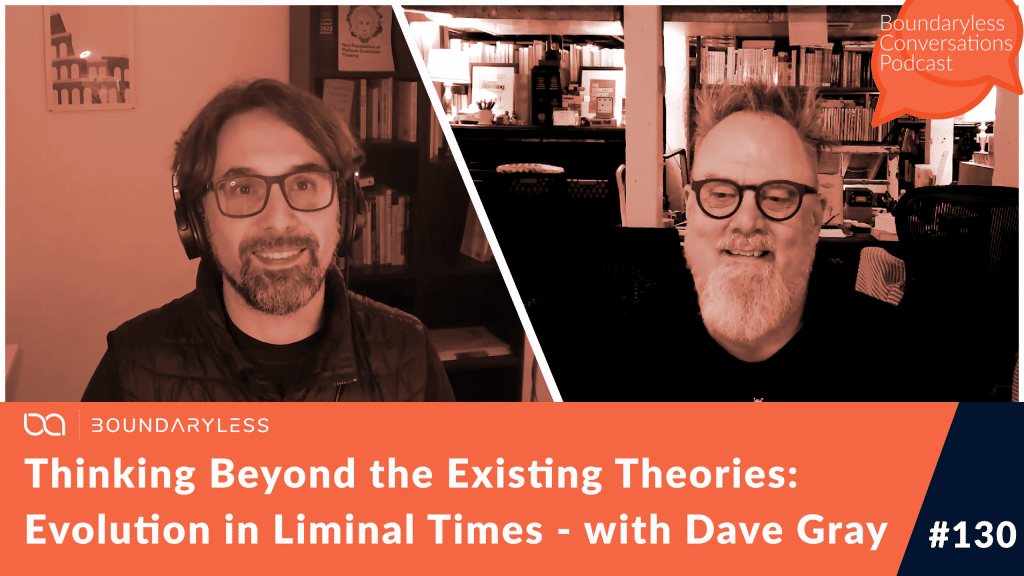
#130 – Thinking Beyond the Existing Theories: Evolution in Liminal Times – with Dave Gray
Dave Gray, acclaimed author and designer, joins us in this episode to explore how organisations can navigate profound technological and societal shifts by thinking outside their traditional theories.
With his decades of helping organisations rethink their value architectures, and his work on liminal thinking and visual frameworks, he reflects on how AI, and other fast-moving cultural changes are reshaping the very assumptions businesses operate on.
We also discuss why the biggest opportunities emerge outside a company’s existing theory, how architectural innovation differs from component optimisation, and why loosening organisational structures can create more space for play, experimentation, and discovery.
Tune in as we learn to embrace ambiguity, enable play, and help design companies that evolve with the liminal times we’re all living through.
Youtube video for this podcast is linked here.
Podcast Notes
Throughout his career, Dave has been a leading voice in helping organisations make sense of complexity. He has co-authored Gamestorming, a foundational playbook for collaborative problem-solving, and written several other seminal books that pioneered reframing organisations as adaptive, networked systems and embracing change.
In this episode, he shares his experiences from his newer ventures like the “School of the Possible”, and “Visual Frameworks”, helping us reframe our mental models and being able to “see differently”.
Key highlights
👉 Organisations struggle to see signals outside their existing theory, categories and mental models: ones that make them efficient but also make them blind during liminal times.
👉 Customers are constantly evolving – which means they often see shifts in value long before organisations do. Paying attention to customers is one of the most reliable ways to notice what’s changing outside your existing theory.
👉 Innovation requires the ability to visualise and hold ambiguity – letting go of familiarity to notice what doesn’t fit the current map.
👉 Architectural innovation means breaking the system into pieces and reassembling it from first principles – not just optimising components.
👉 Failure is essential – most experiments will fail, but a few (like AWS for Amazon) can redefine the complete business.
👉 Paying attention to anomalies and accidents can unlock entirely new markets.
👉 You can’t think your way into a new worldview, but you act your way into one through play, prototyping, and exploration.
👉 Looseness, redundancy, and play at the edges enable organisations to notice weak signals and adapt faster than tightly optimised systems.
This podcast is also available on Apple Podcasts, Spotify, Google Podcasts, Soundcloud and other podcast streaming platforms.
Topics (chapters):
00:00 Thinking Beyond the Existing Theories: Evolution in Liminal Times
01:30 Introducing Dave Gray
03:28 At the Inflection Point: AI, Media, and the End of Business as Usual
20:35 Building Constraints in Innovation
24:08 The Outside-In Perspective for Organisation Building
30:50 Building businesses with new theories of value
42:18 What’s the future of customer co-creation?
47:47 Breadcrumbs and Suggestions
To find out more about his work:
Other references and mentions:
- Gamestorming
- Platform Design Toolkit
- The Connected Company
- Visual Frameworks
- Saras Sarasvathy
- Clayton Christensen
- The Innovator’s Dilemma
- Peter Drucker
- Julian Bleecker
- Near Future Laboratory
- Fabien and Nicholas – Design Fiction
Guest suggested breadcrumbs:
This podcast was recorded on 13 November 2025.
Get in touch with Boundaryless:
Find out more about the show and the research at Boundaryless at https://boundaryless.io/resources/podcast
Twitter: https://twitter.com/boundaryless_
Website: https://boundaryless.io/contacts
LinkedIn: https://www.linkedin.com/company/boundaryless-pdt-3eo
Throughout his career, Dave has been a leading voice in helping organisations make sense of complexity. He has co-authored Gamestorming, a foundational playbook for collaborative problem-solving, and written several other seminal books that pioneered reframing organisations as adaptive, networked systems and embracing change.
In this episode, he shares his experiences from his newer ventures like the “School of the Possible”, and “Visual Frameworks”, helping us reframe our mental models and being able to “see differently”.
Key highlights
👉 Organisations struggle to see signals outside their existing theory, categories and mental models: ones that make them efficient but also make them blind during liminal times.
👉 Customers are constantly evolving – which means they often see shifts in value long before organisations do. Paying attention to customers is one of the most reliable ways to notice what’s changing outside your existing theory.
👉 Innovation requires the ability to visualise and hold ambiguity – letting go of familiarity to notice what doesn’t fit the current map.
👉 Architectural innovation means breaking the system into pieces and reassembling it from first principles – not just optimising components.
👉 Failure is essential – most experiments will fail, but a few (like AWS for Amazon) can redefine the complete business.
👉 Paying attention to anomalies and accidents can unlock entirely new markets.
👉 You can’t think your way into a new worldview, but you act your way into one through play, prototyping, and exploration.
👉 Looseness, redundancy, and play at the edges enable organisations to notice weak signals and adapt faster than tightly optimised systems.
This podcast is also available on Apple Podcasts, Spotify, Google Podcasts, Soundcloud and other podcast streaming platforms.
Topics (chapters):
00:00 Thinking Beyond the Existing Theories: Evolution in Liminal Times
01:30 Introducing Dave Gray
03:28 At the Inflection Point: AI, Media, and the End of Business as Usual
20:35 Building Constraints in Innovation
24:08 The Outside-In Perspective for Organisation Building
30:50 Building businesses with new theories of value
42:18 What’s the future of customer co-creation?
47:47 Breadcrumbs and Suggestions
To find out more about his work:
Other references and mentions:
- Gamestorming
- Platform Design Toolkit
- The Connected Company
- Visual Frameworks
- Saras Sarasvathy
- Clayton Christensen
- The Innovator’s Dilemma
- Peter Drucker
- Julian Bleecker
- Near Future Laboratory
- Fabien and Nicholas – Design Fiction
Guest suggested breadcrumbs:
This podcast was recorded on 13 November 2025.
Get in touch with Boundaryless:
Find out more about the show and the research at Boundaryless at https://boundaryless.io/resources/podcast
Twitter: https://twitter.com/boundaryless_
Website: https://boundaryless.io/contacts
LinkedIn: https://www.linkedin.com/company/boundaryless-pdt-3eo
Transcript
Simone Cicero
Hello everybody, and welcome back to the Boundaryless Conversations Podcast. In this podcast, we explore the future of business models, organisations, and society in our rapidly changing world. Today, I am solo with no co-host, but I’m more than happy to be joined by someone who sort of belongs to my pantheon of inspirations, Dave Gray. Dave, welcome to the show.
Dave Gray
Thank you. So happy to be here, Simone.
Simone Cicero
Thank you so much. Dave is, I mean, so many things, but mainly for me, I think he’s an author, designer, he’s the founder of XPlane, someone whose work has, as I said, very concrete impact on my own journey. His book, Gamestorming, was for me personally the doorway into the whole idea of facilitating using structured games, visuals, and templates to hold people together in challenges, in design and organisational challenges that brought me to work with organisations the way I do, with the platform design toolkit and all the toolkits I created during the years.
Dave is also the author of many other books, including The Connected Company, which was pioneering in, let’s say, reframing companies as networked complex adaptive systems platforms, and Liminal thinking, explores how our beliefs shape how we can or cannot transition through changes.
And I think this is a good topic for the conversation today. Dave also runs the School of the Possible, which is an experimental community for people that are exploring how to enable their own personal potential. And his latest project, Visual Frameworks, gives you patterns to help you think creatively, visually, and reframe the way you think. And I think you should really look into that. It’s a language of patterns, let’s say.
Dave, you have done so many things, so many relevant enabling things. Really, you have enabled so many people to grasp the complexity of change and organisations. So, you know, maybe a good starting point for us in these vast experience you have is to start from the liminal times that we live today, both as individuals, organisations, and maybe ask you how can we keep ourselves to think through the changes in a way that we are less anchored to what we are or what we used to be in a world that every day it’s less there, everything is changing, the future is coming faster.
So how do you approach these liminal times?
Dave Gray
Well, there’s a lot of, so technology, as we all know, it’s always moving forward. There’s always something new happening. I do believe that we are kind of an inflection point in a lot of ways right now, globally. AI has, is I think probably one of, if not the most disruptive technology of my lifetime.
We’ve all lived through a lot of change. mean, the graphical user interface on the computers was the first major one in my life. Then we had the internet. Then, the internet became mobile, available on the smartphones, which changed a lot more than I think people were anticipating. And now AI is, I think, of all those probably the biggest and most transformative and these changes are really really hard to – you know if you look back and go well, you know, we see things like Airbnb or uber You know Uber is something that wasn’t possible before smartphones and mobile internet.
It just wasn’t something that could even be conceived of we look back and it’s like well, that’s pretty obvious, you know. You think about things like cloud-hosted infrastructure that Amazon really pioneered with Amazon Web Services. What happened there was Amazon had their own infrastructure. They had to build a very innovative infrastructure in order to run their company. And then they just decided to expose it to the public.
So these things, mean, lot of these things that we kind of take for granted, you know, subscription services like Netflix, things that are on demand, and cloud infrastructure is another example that Airbnb, Uber, these things are the things that new technologies make possible are really, really hard to see until you’ve stepped outside of, know, into a new paradigm or into a new way of thinking about things.
And, you know, it’s like, it’s almost impossible if you’re a hotel to think of a next generation looking like something like Airbnb, or you really don’t, you don’t even own a building. You don’t own anything. You own a platform. And I’m sure you’ve had a lot of conversations being in the platform design world about companies like Uber and Airbnb that don’t actually own anything. Now, what AI is making possible is really, really hard to see right now.
And I think the one thing that – Anyone who is running or is in an organisation right now, large or small, should be thinking about is whatever AI is going to be, whatever AI is going to enable – It’s not going to be within the existing theory of your organisation and your market, your customers, your capabilities. It’s going to be completely outside and orthogonal to your current theory of business.
So, I mean, every business has to on the one hand, you have to execute on your existing business model. If you have a hotel, you have got to run the hotel. But you also, I think, in order to be really taking advantage of new technologies, you need some ability to perceive the things that are outside of your theory. In other words, new facts, new things.
There’s also, In addition to AI, I think we’re also in a very fluid media environment, which changes a lot of it’s really changing society in a lot of ways. We’ve got, know, we’ve, learning that social media by its very nature tends to create polarisation. And, you know, in the very way that it runs embedded in the business model is a certain, it incentivises rage and tribalization or polarisation, what have you.
And that’s affecting our nation-states and our global society in some really significant ways.
So I think that’s really important, you know, and when you combine that with AI and you start to realise that, you know, the facts about the world can be anything that anyone wants to imagine them to be, and they can start.
You know, and that stuff is, I don’t know if polluting is the word, but that stuff is infiltrating our media environment in such a way that I think it creates a lot of, well, I mean, it’s one of those moments where it’s really, really hard to see what the next five years is going to bring. It’s just almost impossible to imagine or predict.
Simone Cicero
Right. Couple of reflections.
So first of all, I resonate with that because I was with an executive a few days ago, actually, one week ago, and we were doing some work in analysing their company, It’s a fintech company, so we were thinking about teams, how the teams connect or should be evolved and so on.
And suddenly he said, and you can see the visionary people, right? He said, you know, let’s not look at teams. Let’s think about the users. Let’s think about the customers, the ecosystem. I don’t want to talk about my organisation. I want to think, I want to push my organisation to let go, to let what they have go and think about new things because things are changing so fast. So I was, my engineering mind was a little bit swamp at the time, but I really said, okay, maybe this is relevant, right? We are in a moment where we really need to look at the things with fresh eyes, right? We need to be ready to think beyond.
One thing that you said, I think is very interesting. You said, as an organisation, you have to be able to think beyond your theory.
I feel like today it’s almost if organisations have to think beyond their identity because the changes that are sweeping the market are so strong that the very idea of organisations as they know them today may really be obsolete. So maybe we still have organisations just because we couldn’t think about new forms of institutions.
And I think, for example, your work with the School of the Possible is related to that, right? Because, for example, you support individuals to leave the organisations.
So maybe there is another space, another third space we can build to create vessels for this future. And lastly, and then I will get it back to you, just wanted to give you some ideas to pinpoint stories, right? You spoke about media.
I think it’s really important to understand the the power of building a story. And I think you are an expert on this, building a story of where we want to go. So I’ve listened to some of your conversations and you make the point that if teens, for example, are not able to visualize the stories and the situations where the users can find themselves, it’s really hard for them to innovate.
So sorry for this putpourri, but this is where the thinking, the doors that your intro brought up to me.
Yeah, there’s so much to dig into. And it’s really hard to see outside of your theory. And I think it’s almost like you have to think in terms of a bifurcation. I mean, you need to have the ability to operate, your current operations, have to, you have to build up some profit in order to have enough wiggle room to start thinking about outside your theory. And, I think the thing that’s, the thing that’s really interesting to me is just think, you know, how do you, how do you learn to see things that the very nature of your organisation is, you know, designed to ignore.
Because in order to get good at anything, you have to focus on certain things, and you have to learn all the things to ignore.
I had an interesting conversation with a friend of mine this week. He was in the Australian intelligence. He was in the CIA, essentially, of Australia. And he was an analyst. He was looking at these reports every day and 9-11 happened. And in these reports, he was seeing, I mean, the US was watching, a lot of his reports were coming from the US. He was seeing Osama Bin Laden, reports about Osama Bin Laden all the time. He was very familiar with this guy and what he was up to. And yet, somehow, this thing happened that nobody anticipated. It was outside their theory.
And then, yeah, it was just complete. was just it was the signals were outside, you know, they weren’t able to see the signals because they’re outside the theory. And then he was in it. He was also in the intelligence community when the invasion of Iraq happened. And like these are really kind of like blots on my own. I mean, I’m on the US. But the whole idea that there were weapons of mass destruction in Iraq, that they weren’t there, they just weren’t there.
Somehow the same apparatus, you know, because of its theory was able to hallucinate something. And he said, I believed it was there. I believed they were there. All the intelligence, you know, so somehow the again, once again, the theory created facts that were not real they were hallucinations. Surprisingly and strangely enough he left the intelligence community and then he got into the Australian version of the SEC, which is I think it’s called ASIC They were the the regulatory financial organisation and then 2008 the financial crisis happened. Again, how did we not see this coming how it was outside the theory?
And I think this is the thing that, and I guess part of it is being an artist and having been trained in art school, part of my training is learning to see outside of what I expect to see, to learn to see what is there and the things that maybe are not on the map or outside the theory.
There is something really interesting about visualization and holding, being able to hold ambiguity in your brain. The brain has a natural tendency, and this is true for individuals, but also for organisations and big systems and governments and everything else. In order to make sense of the world and operate in it and have a company, you have to put things into categories. You have to have things like a funnel.
Prospects, you know customers you have to separate, you know customers, know returning customers loyal customers from other ones you you you can’t really operate a company without having these categories. But in order to innovate in order to see outside of your existing theory you have to let go in some ways of your existing categories because they’re gonna keep you from seeing really important things that you’re going to need to understand.
And there’s a woman named Saras Sarasvathy. So here’s my first breadcrumb. She wrote a book. I think she wrote a book, but she did a bunch of research into effectuation. And effectuation is her version of, you know, we tend to think in terms of cause and effect. And so we think of creating causes to create effects.
And her work is very oriented towards beginning with the end in mind thinking about the effect and then you know generating the the way to get there. What she did some really interesting research and I can we can go into the details of how she did it because I think how she did the research is also very interesting but her find her one of her big findings was that the way that successful entrepreneurs and businesses the way that they orient themselves in possibility space is they start with who they know.
So they start with, know, like what they know and who they know. So that would be for an organisation that would be starting with capabilities and customers, partners, existing relationships and interdependencies, interrelationships, and interactions. And they just start with that.
And with no preconceived notions, what is it that we have the capabilities to do? What is our muscle? What are the things? The term, I don’t know you’ve heard the terms architectural innovation versus component innovation. Component innovation is when you have an existing business model and you’re optimizing. So this would be like adding AI to what you’re already doing. It’s like to speed it up, make it work better.
Architectural innovation is when you tear the whole thing apart. And this is maybe what your customer or your friend was talking about. You take everything apart and you put all the Lego blocks on the ground and you begin from scratch with some theories, some questions, some provocations, some prompts. And those prompts could be things like, what if, what if we decided to be like, Facebook or Google and give it the product away for free?
How might we design a business if we gave it away, if everything was free? Or maybe looking at a business model like Netflix. What if we made, what if, you know, let’s say we sell products today. What if we made, what if we sold a subscription instead of a product? And you start with some questions. You look around at the world, you see what’s going on. You start with some questions that are gonna lead you out, that potentially might lead you outside of your theory.
And the more crazy, in some ways, the more crazy, the more incoherent they are with your existing theory, the better. Because you want ideas that might sound ridiculous. Well, what do you mean give it away for free? Or how could we be, and Facebook is an example of this, how can we get the customers to do all the work? Facebook is a newspaper, really; that’s all the content is generated by the customers. Instagram, similar.
What might be, what if we, what if we have an industrial product? What if we were to sell directly to consumers or what if we, I mean, the list of possible questions is endless, but to generate some questions that you truly don’t have the answer to even some questions that might seem totally ridiculous and then start creating some explorations. So, and I think you have to explore multiple.
alternative theories. And if we look at the way science and technology and other things innovate, the real innovations come from outside, almost always are coming from outside the existing theories. So, you know, I think that, you know, of course you got to operate your existing company and you got to, you got to, execute on the things that are keeping you alive.
But I think it’s also important to recognize that no business model is going to be successful forever. I mean, you mentioned my book, The Connected Company, and a lot of what I did in that book was kind of reverse engineering Amazon, who is, I think, one of the best companies at operating extremely efficiently while constantly running experiments. I mean, there’s a lot of experiments that failed, right?
Remember the Amazon Fire, Amazon Auctions, know, a lot of the experiments fail, but there’s a few of them like Amazon Web Services that are actually so successful. I believe Amazon Web Services is more profitable than, and maybe even more revenue than Amazon, the store. So Alexa is another, I think one of those that’s a successful experiment that still has a lot of, still a lot of runway and ground before it.
So I, I, I talk a lot about Amazon because I think they’re one of the most innovative companies on the planet. I have to say I’m an investor in Amazon. I’m a customer. have a lot of bias on that, but I do believe that, they’ve done a great job of balancing execution and exploration.
And I think they’re a great example to look at if you want to think about how you might do that as an organisation.
Simone Cicero
I was curious to ask you first somewhat practical question and then I have some more deep reflection. When you start from architectural innovation, so you look at your organisation as a set of capabilities, ideas, thesis, theories and so on. My question is, how do you constrain a little bit? what do you keep from your existing identity? What is that it enables you versus it stops you to think beyond?
So because otherwise you start fresh every day and I don’t know maybe it’s maybe it’s a good idea to start afresh but my question is like what do you bring with you where will you start from?
Dave Gray
I mean, any company has a ton of assets already.
So I think it’s just like, even if I were to think about myself, right? As an individual, you know, I sold my company in 2022. I had to think about what do I want to do next? I think it’s good to start with, okay, so what are the things that you really are good at and start to break that down into components, you know, and start to break it down to pieces. You have capabilities. You might have factories. You might have really good relationships with your workers. You may have customers who are very open-minded. You may have customers that are very detail oriented.
What you want to do, I think, to begin with is to start deconstructing and separating out the things that you do have that are working. You may have a pile of cash. You may be able to buy companies that have very different theories and learn from them by buying them.
Cisco did that for a lot of years. They grew through just acquisition and buying every company that did anything that seemed even remotely related to what they were doing and incorporated a lot of innovation and new ideas into the company that way.
But I think the reason that they call it component innovation is because when you’re innovating on an existing product or service like a car. You know you have all these things that are already built in you know a certain way that brakes are done certain way the engines done. You’re trying to optimize and make the thing that already exists better. You’re trying to improve it when you do component innovation.
Architectural innovation, you’re actually looking at the way that those things are all constructed so what the reason that Tesla was such a such a kind of a shock to the auto industry was because they were doing architectural innovation.
They kind of went back to the drawing board and started saying, what could a car look like if we start with first principles and we make it electric? And we think about, if you think about what Tesla has done, they’re innovating not just in cars, but in electricity and in the electrical grid, and they’re putting up power stations, they are making home batteries. They’re thinking about, they’re doing some, innovation that, is outside of the current components. You don’t ever need to go to a gas station, right? If you have a Tesla, but you are going to need to recharge. You’re going to need to do things like swapping batteries out. So they’re, they’re not just, they’re just, they’re rethinking a whole, whole system from the infrastructure all the way up.
I they’re not changing the roads, but even actually in some cases with the tunneling company, the boring company, they are actually even changing the roads. They’re drilling tunnels under cities as a way to think about transportation. I mean, Tesla’s another interesting company.
Simone Cicero
What is the role of in this process, right? There is a lot of inside out, I mean, to some extent, a lot of inside out perspective, right? What we have, what are the capabilities we have, how they can be recombined? What is the role of the outside in? So what is the role of understanding what needs are emerging, what ecosystems we are in?
Essentially also, what is the question around what value we want to enable. So how do we choose what to do versus just looking at what we are able to do and then recombine it to capture another opportunities? I’m curious to hear what is the outside-in perspective normally when you work with companies or what suggestions you have.
Dave Gray
You mean looking at the environment, the outside environment? Yeah, so here’s one thing about, so technology, we can guarantee that technology is going to change, right? It’s going to innovate. New things are going to come up that we didn’t anticipate or expect. That’s an external thing. But customers also, right? Customers are going to get older. They’re going to die.
There’s going be a whole new generation that’s going to have a whole new set of principles, ideas, thoughts, approaches, they’re going to have different interests. They’re going to be interested in working. You know, if you have relationships, uh, you know, with, businesses and, and the people that you have relationships with retire, then you got a whole new, uh, set of relationships that you’ve got to build.
Everything outside in the world is constantly evolving. And as a company, you know, as you get good at something, you tend to be not evolving. You tend to be like essentially oriented within a theory and operating within the theory. There’s great theories and some theories can last for a long, long time, but I think, so I believe there’s a combination of paying attention to what, is going on around you and paying attention to what your skills are and how they might be relevant.
A lot of stuff happens by accident. Honda was a Japanese company. They were interested in bringing motorcycles into the United States. I think I got this one from Clayton Christensen, innovators dilemma guy, jobs to be done guy. And he talked about a Honda and how they wanted to enter the US motorcycle market.
And the biggest player in the US motorcycle market at the time was Harley Davidson. So their first attempts to enter the motorcycle market were these large kind of cruising motorcycles that are very Harley Davidson like. But they also had these small little kind of delivery motorcycles that were used in Japan and in Asia that were they didn’t even think about trying to bring those into the US market. They’re like, they’re used, they were used for people given, you know, grocery deliveries and, you know, messengers and that kind of thing in Japan.
But they had some of those laying around and they were in Southern California and they would go out and ride those little motorcycles around on the dirt trails. And, because they did that, they had, they started getting a lot of people saying, “Hey, where’d you get that motorcycle? Where’d you get that bike?” So some of this stuff, and that’s how they entered the dirt bike market. They basically invented or they, they innovated the US dirt bike and they discovered that they were better off selling those things, not through automotive or motorcycle dealerships, but through bicycle shops. I may be getting some of the details of that story wrong. Cause it’s been a while, but.
That’s the kind of thing that you just can’t necessarily anticipate. You have to be paying attention to things that are outside. Like that’s a good example of something that was outside of the theory, right? The theory was that we want to be like Harley Davidson. And the thing that was completely outside the theory that just happened, you know, it happened by accident, but it happened by paying attention to things that were outside of the theory, if that makes sense.
So in order to have those things happen, though, you have to have a certain amount of play and openness in your… It’s not going to happen if you’re not out there doing stuff. So I do think that one way of saying this is you can’t think yourself into a new way of acting, but you can act yourself into a new way of thinking.
So by doing things that are playful or don’t make sense or are outside the boundaries or are prototypes or provocations or experiments, by making a habit of making it possible within your organisation for people to try new things, to play, to experiment, to go outside the boundaries of the theory, because people naturally do that.
People naturally will resist any kind of control system. So it makes the job more fun for people. And it also creates some opportunity for you to make some discoveries that you wouldn’t have if you’re, you know, tightly optimized and controlled system.
Simone Cicero
I was about to ask you how do you enable this type of thinking in an organisation, right? And it looks like a good way to do it, and maybe not the only one, but a good way to do it is to create a space for play.
Dave Gray
Yeah, loosen up.
Loosen up. I mean, so much of organisational lore is built around efficiency and optimizing and reducing even agile software development. And even a lot of things are about eliminating waste. Even the Toyota production system, it’s about eliminating waste. But I think there is something to be said for a loose coupling, looseness in the way that the parts play together, even redundancy, because it gives you some space to try and gives people at the, most of the time the people who are most likely to see changes in the environment are out at the front lines.
They’re the people who are working at the counter serving the drinks or they’re the people who are interacting directly with customers. They’re the delivery drivers. And those are the people who are in direct touch with the marketplace. They’re the most likely ones to be able to see something that’s an anomaly, that’s outside the theory, because they’re outside the organisation all the time.
They’re in the customer world, so they’re going to be in a position to notice things that you’re not going to be able to notice from headquarters.
Simone Cicero
I think this resonates also with our experience in creating an adaptable organisation that can do these progressive adaptations. Sometimes they can jump farther. So the idea for us is to break the organisation into many pieces so that you obtain two things. Everybody’s in touch with the customers so they can see the behaviours evolving.
So either a business customer of a end user. And also this has the effect of reducing the chain of dependencies in the organisation. Because imagine you have an organisation which is made of nodes. But I’m a part of the organisation. Maybe I depend on another node in the organisation. But it’s not hierarchical bundling that I have. It’s more like supplier relationship.
So I can actively diversify my relationship so that I can maybe think of, you know, maybe I can look into another supplier, right? So this has two results. One makes the organisation more resilient. Two, I think it makes also the nodes more free to experiment because at the end of the day, there’s not so many dependencies on me that I really cannot move, right?
I can dynamically look for new opportunities because I’m thinking for myself, right? I am thinking for myself in terms of as a team, as a leader, I can think of something that I want to do, not just something that I’m supposed to do for the organisation. So I think this gives me a segue into another question that I wanted to ask you.
It looks like the world is accelerating and the fact that we are more aware that we can do architectural innovation, continuously combining things, is speeding up the innovation pace in the world. Certainly the world looks faster, evolving at a faster pace now.
Also, maybe because we are aware that we can recombine the cost of transactions is going down. So there is this tendency to create something new, play, and so on.
At what time, to what extent, this continuous process leads us somewhere where we can think of new theories, but also new theories of value. So when you say you need a new theory, you need to develop new theories, these new theories are emerging from the play and interaction.
My question is, how we constrain to some extent to think in terms of profitability and business modeling and so on, or there is a space where we can really think of new forms of value for a world that is emerging now, right?
And new organisational agreements, new customer agreements that look into I don’t know, creating different forms of value that, for example, resonate with myself as an entrepreneur. I want to do something because I am passionate about it, not just because it has a sustainable business model and it makes money, right? I guess this is the traditional driver, but I’m wondering if this continuous recombination has some chances to bring us into new theories of value.
Dave Gray
Ya, I do. I think so like one piece of the equation that I think is really important is you want to be, we talked a little bit about you need to be out there in the environment. This perception isn’t just, you’re looking at the landscape with a telescope from a tower. You have to actually be out in the environment, exploring and moving around in order to learn things.
Whether you’re a person or a bird or a or a bear, you’re only going to learn about your environment by moving around and interacting with it. So that’s one piece. You’re going to find things that if you’re really exploring and you’re asking a lot of questions about what’s possible and you’re exploring those adjacencies, you’re going to come up with some ideas for experiments, prototypes, explorations.
I think it’s always going to be a judgment call – how much time and energy you want to put into those things. But I think that for me, exploring value is something that has to be happening all the time. So that means putting prices to things. Seeing what people are, they’re a business or an individual customer, the three things that they have to invest in you are their time, their attention, and their money.
And it’s very important, I think, to be constantly evaluating how much of those things you want. For example, and there are different kinds of value equations, right? With Amazon, I don’t want to spend, I’m not going to Amazon to have an experience. I don’t want to spend a lot of time there. The value of Amazon to me is the less I imagine that I want something and it’s in my hand. And the faster that happens, the more value that Amazon’s creating for me.
Whereas with something like Netflix, it’s a totally different value equation. The more time that I spend watching stuff on Netflix, the more value that I get. So on the one hand with Amazon, the less time I spend, the happier I am. Right. But with Netflix, the more time I spend, the happier I am. So they’re very different kinds of value equations.
I think it’s useful to think about those kinds of things. What is it that you are actually – what is the value that you’re providing to customers? I would say it’s extremely common. maybe I’ll be interested to hear your thoughts on this, but I think it’s extremely common that the company or the individual or the consultant who is providing the value is often got a very different idea of what the value is than the customer has.
What I have discovered, at least in my journey, the most innovative ideas have almost always come from customers. One question I love to ask my customers is, hey, you know what? When we first started working together, you had an idea of what you were buying. And now after having the experience, I’m curious if you think you got what you expected.
What I told you was going to be, or did you get something different or did you get some other kind of value from it? And you learn a lot. One of the things about feedback, we try and build, build these systems for feedback, you know, where we’re getting people to rate and rank things and you know, there’s some value to that.
But the real value is in the conversation that you can have that gets you out again. If you’re going to have a survey, you’re only going to get answers that are inside your existing theory.
If you have a conversation, if your feedback is open ended and you’re asking open questions and you’re looking, you’re actually exploratory and your feedback mechanisms, you’re going to learn a lot more about your value.
You know, like I remember talking to a customer once. Okay. So what was it like? And well, I thought you were just, I thought we were just going to come in and you were going to draw a picture and my team was going to describe it. And we were going to, we were going to, it was going to be pretty easy, simple thing. And then we got in the room and you started asking questions and I started to hear my team and I started to realize how radically different their conceptions were about our product, not only from me, but from each other.
And I started to get this sick feeling in my stomach, like, Oh my God, we don’t know what we’re doing. none of us have a clue what we’re actually selling here. And so, but this is his way of actually describing the value that I was bringing to the table was we didn’t even know how far apart we were until we started talking to you.
And then after we talked to you, we started to, you helped us figure that out. Now that was something that I never would have anticipated was the value that I was creating as a visual.
Simone Cicero
I was thinking to Peter Drucker’s point that an organisation exists only to create and keep a customer, right? So essentially, I was picturing what you were saying around this idea that at the end of the day, there is a relationship between customers and companies, in general customers and suppliers, let’s say, consultants, whoever.
There is an element of creative co-creation where bot need to create value for them, right? So I like this idea of looking at ourselves, for example, as organisations that supply certain customers, mainly from the perspective of enabling this process of co-creation.
So it’s not about you as an organisation. It’s really about your role, the way you participate into these process of discovery and co-creation of value with customers.
So I think that this is radically different way to look at organisation that most of the organisations we work with and we know tend to look at themselves, because most of the organisations are very inside out, very about your team, my team, my budget, your budget. Nobody cares really for the customer. And nobody cares about creating these spaces of play with the customer. What do you think?
Dave Gray
Yeah. I agree a hundred percent. think, so the most interesting and innovative ideas are going to be, they’re going to sound incoherent at first. They’re not going to make sense. If they’re coming from outside of your theory, they’re going to sound crazy or strange. The most likely place for those kinds of ideas to come from is customers.
The way that the company can create the potential for hearing these things is by creating spaces and prototypes and objects and prompts and questions that allow the customers to participate in that invention process with you. So you don’t know what they’re going to say, but you can create a space where they can play.
You can create a space where you can play with them. You can create a space where, or you can create a prototype or an object or even an imaginary thing. There’s a friend of mine named Julian Bleecker, who you should probably talk to if you haven’t for your podcast, who runs a group called the Near Future Laboratory. He used to be at Nokia. Do you know him by any chance?
Simone Cicero
Yeah, I know him. We had Fabien in the podcast recently.
Dave Gray
But the work that he does, I think, is quite interesting. He is creating, I think he calls it speculative design. But part of what he does is create these scenarios or ideas, what-ifs about possible futures that can become, I think, interesting fields for those kind of conversations. I think there are a lot of ways to do that. I think that that’s just one.
But I think I do believe that customers, they’re not going to come and if they have a crazy idea, they’re not necessarily going to come and share that with you unless you create an environment where that’s invited.
And so I think the the more you can create opportunities to involve your customers in your innovation process, I think the better chances you’re going to have to get some truly new, you know, kind of outside your theory kind of ideas.
Simone Cicero
Yeah, I think what we’re talking about here is really the transition from an industrial concept of organisation so that somehow set the, so basically create the needs, you know, because they want to have a planning and scale and they need this to make money basically, know, they need to manufacture needs for people.
And in general, the industrial concept of society, a society that manufactures expectations, both in education, healthcare, in products, whatever, into what really is a post-industrial organisation. I suspect that AI is going to have a role in this. I am also, if you read AI from a Marxist perspective, I think this is a very powerfully de-alienating technology because it’s enabling, you know, in a way that no other technology has so far.
So I think what we are witnessing is this transition towards post-industrial organizing. And in post-industrial organizing, the fascinating thing is that the need is at the center. The user is at the center, right? So the organisation only exists to serve the user, to enable the user to create an answer to their own needs. And the fascinating question that they keep having, and I don’t know if I’m going to have an answer soon, but –
I believe that now the responsibility shifts from the organisation to the user, right? And I’m curious to see in this shift of responsibility on what we create, what product we build.
Weave this shift from the organisation, which doesn’t care about the environment, the externalities. It doesn’t care about anything than money because it wants to exist as a system. If you shift into the user, what happens to the products? What products are we going to have? What services are we going to build? Because the responsibility now is in the users. And the users are embedded into context. So I’m really curious to see what’s going to happen. I don’t know, but I think this shift is massive for companies is gonna be very hard to change it all, right?
Dave Gray
Yeah, I mean, I think, I think the new business models are going to come. They’re either going to come from inside existing organisations or they’re going to come from the periphery, from the outside, from customers, you know, that Honda story, you know, it happened to work out well for Honda, but if Honda hadn’t been good at listening to their employees, they probably would have gone off and started their own dirt bike company. Right.
And that happens a lot too is like the company doesn’t know how to listen or it doesn’t have a the brain it’s not organized in such a way that it can hear or see or perceive even perceive these interesting anomalies these positive deviants is whatever you want to call them. So you want to be able to you want to be able to if you’re an existing organisation, you want to be able to keep your eyes open for these things and you want to be creating opportunities for them to happen.
You don’t and to your point earlier about, you don’t want to spread yourself too thin. You want to focus on the things, you don’t want to a set of hypotheses and experiments that you’re, you let’s say you might want to have a certain number, a portfolio of these hypotheses and experiments that you’re constantly running.
But I think any hypothesis or experiment should have a time span, you know, within which you evaluate. And what are you evaluating?
You’re evaluating – what kind of time and attention and money is this worth to a customer? So you’re testing those things, but you’re also testing what did we learn that we can apply somewhere else? what have we learned that maybe we can bring some of these new ideas back into the organisations? I think it’s city, no, there’s a bank in the US. I’m trying to think of the name of the bank.
the, name it’ll, it’ll come to me, but they, they have a very interesting innovation lab setup. They bring essentially outside. It’s kind of like a, a graduate school course. So they bring people into this innovation lab, either from within the company or new people coming in from outside the company. I don’t know if they ever bring customers in.
The name of the bank has escaped me, but I’ll probably think of it by the time we’re done. They come in, they go through this period. basically get to do a project. It’s an experiment. They formulate a hypothesis. They, they, they work with it. And one of the ways that a lot of these innovation projects fail is that, they have to hand up, they have to get something, they get a promising experiment. Then they have to hand it off to people who are going to operate in the organisation.
But what this bank does differently, Capital One is the name of the bank. So what Capital One does differently is, if you have a successful project, you actually go with it into the company and you build it yourself, just like a startup. You’re now, it’s not like you have to have a handoff. The expectation when you go into the innovation system is that you’re going to create a product and then you’re going to be the director or the VP or whoever who’s going to run it. It’s up to you to turn it into a business unit or a new product line or what have you.
And I think that’s a really interesting way to, you know, just like we breathe in and we breathe out, you know, like to have a system that where we get, we eat food, you know, the, the system that, you know, every organisation, every system has things that are outside of it and things that are inside of it.
And the challenge of innovation is a lot of companies have trouble. They can innovate, but then when they try to bring this stuff in, this is the typical example of a company that they buy a product and then it dies because they’re unable to, they buy a whole company and the company, you know, isn’t successful for that reason.
So, the idea, I think this is a really interesting and very promising philosophy for how to run innovation is that there is no handoff.
Simone Cicero
Yeah, totally. I mean, it’s very resonating with, for example, what Haier is doing with the micro enterprises, right? Very often they have these, first of all, they have these innovation spaces where people can test and try new things and interact with the employees. Often the new things come from people that are outside of the organisation, so new employees, and they have these structured micro enterprises where you basically run your own company inside, but also another company like Flagship Pioneering as a similar process – they created these companies inside and then incubate them and run them as separate companies. I think this is really a pattern we can recognise.
So Dave, we are approaching the end of the conversation. So before we close, first of all, thank you for reminding me about Sarah Stratton’s work, because she was in the bucket list for a while. And maybe I will try to reach out to her and bring her on the podcast.
So besides this break run, what are other break runs that you want to share with our listeners that they can pick and learn from?
Dave Gray
Well, I would love to drop the visual frameworks project that I’ve been working on into the conversation. I think there’s a ton of possibilities. It’s a toolkit that I’ve been working on, similar to Game Storming, but it’s oriented toward perception and seeing and learning to see things differently.
You know, we’re always everything that we think and do is based on models and the models in the sense are the theories that we have about the work that we do. And visual frameworks just offer a way to cycle your brain through random different models and think about, you know, okay, what if, what if, what if I saw this through the lens of a menu or an iceberg or a tree or how might, how might I think about this that I’m thinking about differently.
So I think they’re a good tool for that. Yeah, effectuation with the Sarah Sarasvati is a really good one. There’s a book called Against Method, which is by a guy named Paul Feyerabend. He’s dead, but the book is still really relevant and interesting. It’s a bit provocative, but he talks about innovation in science and how that happens.
And it’s not the kind of thing that you would expect. mean, we think about the empirical method. A lot of innovation in science is a lot more creative than we maybe give it credit for or think about. So that’s a really, if you want to stretch your brain a little bit, that’s a good one.
There’s a book called Seeing Like a State, which I don’t remember the author, but it’s a really good book about how your theory has a tendency to lock you into ignoring things that are kind of important. So the way that a nation state maps and categorizes its constituents makes it blind to certain things. And I think that’s a really interesting, deeper book to go into. And I would say anything by William James.
William James is a early American philosopher and psychologist one of the they call him the father of psychology and in the US But he was a he was a contemporary of Freud and he but he had some has some really interesting ideas about belief and perception a lot of his ideas are in the liminal thinking book that I wrote and I think if you want to you actually want to go deeper on perception and how what we, you know, what we believe influences what we see, how our theories create blind spots I think William James is a good person to spend some time with.
Simone Cicero
So I need to add this to the breadcrumbs as well, which is just out since a few weeks. GameStorming 2.0, you said to me in the preparation chat that there is some guidance for remote workshops, so it’s going to be useful for many listeners. And also for people like me who make canvases, there is a chapter that I still need to read about separating crappy canvases from the good ones.
Now I am in terror to read it because. I’m sure that mine will be crap, Dave, I mean, was an amazing conversation. II feel like it’s like the seventh series of the podcast. I don’t know why we waited so long to have you on the podcast, but you know, that’s life. And I’m sure that this is going to be the first of many. So thank you so much for your time. I hope you enjoyed the conversation a little bit.
Dave Gray
Very much, very much so. Yeah, it was a pleasure. Thank you. Thank you for having me, Simone. It was a real pleasure. And thank you for forcing me to express out loud some of these ideas. Because I think they’re, I do think they’re, you know, I’ve been a little bit out of the corporate consulting world for a while, but I haven’t stopped thinking and experimenting. it’s good to have an opportunity to reflect back some of this stuff, especially after a little.
Simone Cicero
I hope that this podcast also brings more people to your work, which I believe is extremely significant. So that would be also a win. For our listeners, you can head to boundaryless.io/resources/podcast. You will find this episode with all the great rates and things that they’ve mentioned today. And of course, like always, until we speak again, remember to think Boundaryless.