#138 – Supply Chains as Complex Systems and their Organisational Implications – with Federico Marchesi
BOUNDARYLESS CONVERSATIONS PODCAST - EPISODE 138
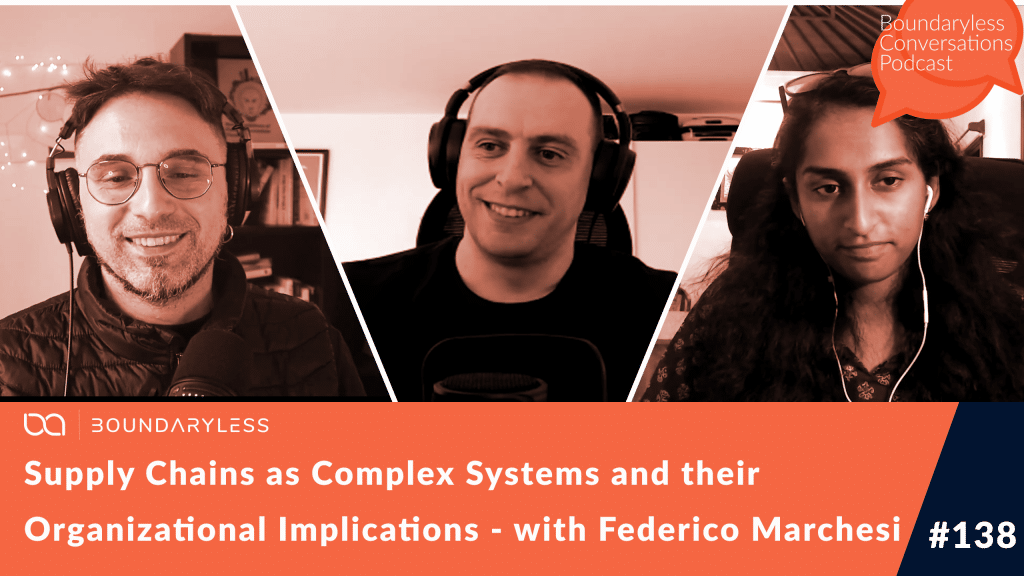
#138 – Supply Chains as Complex Systems and their Organisational Implications – with Federico Marchesi
Federico Marchesi, supply chain strategist and author of the Hacking Supply Chains newsletter, joins us to explore how disruptions, variability, and global constraints are not anomalies, but structural conditions that organisations must design their supply chains for.
Drawing on his experience across global companies like Haier, Federico reflects on a key shift in how we should understand supply networks today: “In reality, we don’t operate a chain, but a complex adaptive system.”
In this conversation, we unpack why adaptability requires more than operational improvements: how modular product architectures can help, and how organisations can become capable of responding dynamically to uncertainty.
From Demand-Driven MRP to the growing role of AI agents in forecasting and logistics, the discussion highlights how supply chains increasingly rely on distributed intelligence and continuous adaptation. Tune in.
Youtube video for this podcast is linked here.
Podcast Notes
For leaders, strategists, and organisational designers, Federico offers a valuable perspective on why supply chains can no longer be treated as a back-end function. Instead, they are becoming a central lever in building complex-aware, resilient organisations.
He speaks on the ideas of supply chain strategic design and why the deliberate structuring of flows, buffers, and decision points is important so that systems can always remain functional.
The conversation also explores the parallels between organisational design and supply chain design, and highlights how structuring companies into smaller entrepreneurial units with clear incentives and autonomy will make them: distributed, adaptive, and able to respond to uncertainty.
For anyone interested in the intersection of organisational design, strategy, and real-world production systems, this conversation is for you.
Key highlights
👉 Supply chains are often described as linear flows, but in reality, they function as complex adaptive systems shaped by feedback loops, multiple actors, and constant variability.
👉 Building resilient supply networks requires strategic supply chain design, not just efficient day-to-day operations.
👉 Modularity in product architecture allows companies to delay final configuration decisions, making it easier to adapt to changing customer demands and supply disruptions.
👉 Adaptive supply chains depend on adaptive organisations – teams must have autonomy and incentives to respond dynamically rather than follow rigid processes.
👉 AI is increasingly augmenting supply chain operations, from improving demand forecasting to automating transactional logistics tasks.
👉 As global disruptions increase, supply chains are shifting from a demand-driven world toward a more supply-constrained reality, where the key capability is delivering value despite constraints.
👉 Organizations must rethink the classic centralised vs. decentralized debate and instead focus on coordinated networks of decision-making.
This podcast is also available on Apple Podcasts, Spotify, Google Podcasts, Soundcloud and other podcast streaming platforms.
Topics (chapters):
00:00 Supply Chains as Complex Systems and Organisational Implications
01:02 Introducing Federico Marchesi
03:00 Supply chains as complex systems
04:41 Key Elements Affecting Supply Chain Complexity
09:25 Supply Chain Planning for Complexity
14:43 Organisational Design and Adaptive Supply Chain Designs
25:44 How do you visualise modularity and adaptive systems?
29:20 What can organisations learn from supply chains?
35:37 Preparing for the future of Supply Chains
41:33 Breadcrumbs and Suggestions
To find out more about his work:
Other references and mentions:
Joe Justics – Boundaryless Conversations Podcast
Guest suggested breadcrumbs:
This podcast was recorded on 03 March 2026.
Get in touch with Boundaryless:
Find out more about the show and the research at Boundaryless at https://boundaryless.io/resources/podcast
Twitter: https://twitter.com/boundaryless_
Website: https://boundaryless.io/contacts
LinkedIn: https://www.linkedin.com/company/boundaryless-pdt-3eo
For leaders, strategists, and organisational designers, Federico offers a valuable perspective on why supply chains can no longer be treated as a back-end function. Instead, they are becoming a central lever in building complex-aware, resilient organisations.
He speaks on the ideas of supply chain strategic design and why the deliberate structuring of flows, buffers, and decision points is important so that systems can always remain functional.
The conversation also explores the parallels between organisational design and supply chain design, and highlights how structuring companies into smaller entrepreneurial units with clear incentives and autonomy will make them: distributed, adaptive, and able to respond to uncertainty.
For anyone interested in the intersection of organisational design, strategy, and real-world production systems, this conversation is for you.
Key highlights
👉 Supply chains are often described as linear flows, but in reality, they function as complex adaptive systems shaped by feedback loops, multiple actors, and constant variability.
👉 Building resilient supply networks requires strategic supply chain design, not just efficient day-to-day operations.
👉 Modularity in product architecture allows companies to delay final configuration decisions, making it easier to adapt to changing customer demands and supply disruptions.
👉 Adaptive supply chains depend on adaptive organisations – teams must have autonomy and incentives to respond dynamically rather than follow rigid processes.
👉 AI is increasingly augmenting supply chain operations, from improving demand forecasting to automating transactional logistics tasks.
👉 As global disruptions increase, supply chains are shifting from a demand-driven world toward a more supply-constrained reality, where the key capability is delivering value despite constraints.
👉 Organizations must rethink the classic centralised vs. decentralized debate and instead focus on coordinated networks of decision-making.
This podcast is also available on Apple Podcasts, Spotify, Google Podcasts, Soundcloud and other podcast streaming platforms.
Topics (chapters):
00:00 Supply Chains as Complex Systems and Organisational Implications
01:02 Introducing Federico Marchesi
03:00 Supply chains as complex systems
04:41 Key Elements Affecting Supply Chain Complexity
09:25 Supply Chain Planning for Complexity
14:43 Organisational Design and Adaptive Supply Chain Designs
25:44 How do you visualise modularity and adaptive systems?
29:20 What can organisations learn from supply chains?
35:37 Preparing for the future of Supply Chains
41:33 Breadcrumbs and Suggestions
To find out more about his work:
Other references and mentions:
Joe Justics – Boundaryless Conversations Podcast
Guest suggested breadcrumbs:
This podcast was recorded on 03 March 2026.
Get in touch with Boundaryless:
Find out more about the show and the research at Boundaryless at https://boundaryless.io/resources/podcast
Twitter: https://twitter.com/boundaryless_
Website: https://boundaryless.io/contacts
LinkedIn: https://www.linkedin.com/company/boundaryless-pdt-3eo
Transcript
Simone Cicero
Hello everybody and welcome back to the Boundaryless Conversations Podcast. On this podcast, we explore the future of business models, organizations, markets and society in our rapidly changing world. I’m joined today by my usual co-host, Shruthi Prakash. Hello Shruthi.
Shruthi Prakash
Hello everybody.
Simone Cicero
Today we are exploring something that is often treated as a given, let’s say in organizational development and even in economy related conversation, the supply chain. And we speak about products, platforms, teams, topology, super ready models, but the underlying networks that move materials, components and energy, and nowadays face real world constraints, because of what’s happening all over the world are frequently assumed as a something that is just there and they shape at the same time what’s possible for companies strategically, operationally and even culturally sometimes.
To help us unpack this, we are joined by Federico Marchesi. Hello, Federico. Welcome to the Bandaryless Conversation podcast.
Federico Marchesi
Hi Simone, nice to meet you and hi everyone. Thank you for having me.
Simone Cicero
Thank you for joining us. Federico is a supply chain professional with a very deep experience. He has spent years working inside the real machinery of some of the most interesting international companies in different industries, home appliances, automotive, retail, and he has been working for worldwide leaders such as Brembo, Whirlpool, and Haier Group. More recently, Federico has been doing very thoughtful public work on the topic, sharing a systems level perspective through his newsletter called Hacking Supply Chains and he’s writing about supply chains as complex adaptive systems and not as linear pipelines as they are not anymore.
We invited Federico because we wanted to make a point. Supply chains are a reality of the economy and driving force in how organizational development can evolve. And if we take complexity seriously, we also need to rethink how our supply chains work.
So first of all, Federico, maybe as a starting questions, you are a big proponent of supply chains as complex systems. This is one of the tenets of your work. So maybe we can start from there. What does it mean to look at supply chains as complex systems?
Federico Marchesi
Yeah, sure. Well, let me start from a bit of personal history. I have a degree. I’m graduated in complex system control. So I did a bit of work on automation and so on. And that’s where probably my background and my work somehow interact and collide. Historically supply chains have been treated as a chain by definition. There is a set of activities that happen one after the other.
There is a set of decisions that are taken one after the other. However, what we see is that in reality, we don’t really operate a chain, but we operate a complex adaptive system. So we have multiple actors in the chain, have multiple companies, we have multiple people that interact in and out. So those actors, they interact through exchange of information, exchange of products, and the interaction between them is complex by definition because there is a feedback loop between those actors.
There is an exchange of information that might actually modify the way those actors compete or interact in the marketplace. And then we experience more and more suppliers becoming competitors, becoming partners, customers becoming competitors, a company competing for the same resource from different suppliers.
So this is the real definition of a complex adaptive system.
Simone Cicero
Definitely. I mean, what does it mean in terms of how organizations, leaders look at this problem? So is there any framework that you have developed in terms of what are the three, four, five, six key elements that have changed in how you look at supply chains, for example, from, let’s say, people’s perspective or a partnership’s perspective or a contracting perspective. So what are the major pieces of your framework as a leader in complex supply chains to ensure that the company you work with is somehow thriving without suffering the incredible changes that we have seen in supply chains in the last, I would say, five, six years, not starting from COVID.
Federico Marchesi
Yeah, sure. Well, let me start describing what is probably the more traditional way about supply chain thinking and organization. Typically, if you look back probably 20 years, you will find a lot of research about how to structure supply chain. Do you want to have a decentralized supply chain operating with single business unit that have the whole capabilities? Or do you want to have a more centralized vertical integrated supply chain with center of expertise with kind of a command and control organization? So this has been back and forth the discussion in business, the discussion in research about how to start your supply chain.
The new normal, and again, I have my own definition. The new normal, a lot of people will say that this is what happened after COVID-19 pandemic. I started to think about changing supply chain a bit earlier when we started to see the first disruption dating back in 2017, 2018, and the first challenges in terms of capital management, logistic, et cetera. So again, the new normal is a bit of a gray area. It didn’t start exactly one point of time.
It’s something that had been probably experiencing in the last 10 years. So in this new normal, my theory is that we need to decouple ourselves from the traditional thinking of centralized versus decentralized. But we need to think more about where we take decisions. And those decisions need to be taken by people that can have access to information, can have access to very quick decision making, with a system of incentive that somehow make sure those decisions are efficient, are taken in an efficient way.
And then we need to have a system of synchronization or coordination for the whole supply chain network. It’s not the typical decentralized versus centralized supply chain. It’s actually a network thinking that fits a lot with the concept of Rendanheyi or decentralized decision making bottom up, but with a strong kind of governance to make sure that the system maintain coherence and maintain efficiency when disruption comes or when a reorganization of the system is needed.
So this is my view about organization.
Now, you were also asking or hinting something about how to think on supply chain and design. I’m a big proponent, and this is a bit the work that I do in my day-to-day life and what I write about and talk about in my speech.
I’m a big proponent of the concept of supply chain strategic design. So that’s what I do a lot in my day-to-day work versus supply chain operation. So those are two equally important activities with different objective. Supply chain design is how we settle or make sure that our supply chain is going to work in terms of the organization structure that we have, how we use the resources, how we exchange information, etc, to make sure that the supply chain can be resilient, can sustain stress, can sustain disruption without breaking. So this is the more work that is done typically on a whiteboard by really thinking and designing through how the flow of material information works. And this is very important.
At the same time, the traditional work of supply chain is operating supply chain. It’s taking the day-to-day decision, the week-to-week, the month-to-month decision about how much we purchase, how much we plan to sell, where we store the material, how we move it around, and so on. So those two work are equally important. The first one is trying to make sure that disruptions don’t happen too often and are not basically stopping the flow of value to customer in the flow cache. The second work is making sure that we can react day to day to the unforeseen.
Shruthi Prakash
Yeah, sorry. So, was just thinking like, if we treat it as two separate, let’s say functions, one of supply chain strategy design versus operational, how do or where do these two combine in the sense that how does the learning from an operational level pass on to the strategy team and that it’s not conducted in, I guess silos and yeah, that the knowledge transfer sort of enabled between the two.
Federico Marchesi
Yeah, so if you look at a typical supply chain, will probably have, I would say, most of the people operating doing the operation work. The design work is something that is done constantly, is done by what they call the synchronization layer. So the few people that are looking at the overall supply chain and are somehow taking the decision to make sure that there is coherence in what is happening.
Now, the exchange of information, this is the beauty of the world we live in today, can happen in a couple of ways. First of all, most companies now work with anything that can be named as a control tower or dashboard and so on. This is the first important input in terms of exchange of information. So having a good exchange of information in a company, having a good control tower, having a good system of reporting is an input for the design.
The second point is the layer, there is not a clear job definition or, let’s say, differentiation between who does the design and who operates the company. It’s more a different mindset. So the same people might actually do a bit of both work.
So they might be the people operating the supply chain of a very specific part of the company or a very specific cell of the company.
However, the same people might spend some of their time rethinking how to organize the supply chain. Again, it’s nothing new from the typical, I would say, supply chain, operational planning, supply chain, tactical planning, supply chain, strategic planning, but it’s more looked from an angle of the design decision. And this is something that is probably a bit new in supply chain. So thinking really supply chain as a blueprint, where you want to literally draw lines and place different model and system here and there to making sure it’s working coherently.
Shruthi Prakash
Yeah, I was watching one of your videos earlier and I think the, let’s say, visual aspect of it was very clear where you were mapping out the different, partners, stakeholders and so on. I think, Simone, if I can jump into, let’s say, one of the main topics that we also wanted to discuss was how, let’s say, you work towards like DDMRP and adaptive enterprises and so on.
I’d love for you to touch upon that and take us through what makes us different from a more adaptive, let’s say, system and how can that be beneficial for organizations versus other methods of supply chain planning.
Federico Marchesi
Sure. Sure. So let me start from the building blocks. Demand-driven MRP is an algorithm, and I like to say in this way, is an algorithm to plan supply chain. And with this algorithm, a supply chain professional can do different thing. Can plan the purchase of material, can plan the distribution of material, can plan the production of a site or anything similar.
DDMRP building blocks is an algorithm. And the whole concept behind that is not something particularly new, but has been formalized in a very nice way is that supply chain as complex adaptive system are impacted by variability. And variability are two of two kinds. There are demand side variability. So my customer, they’re ordered pattern, the prediction about what I will sell in the future is variable.
And there are also what we call supply side variability. So the product that are entering in my chain are the flow product is valuable. So the whole algorithm is designed and the thinking is that we want to decouple demand from supply to make sure that we don’t transfer those variability across different parts of the chain. So this is the building block.
The DDMRP itself is a extension of these building blocks across the whole supply chain network. So the idea is to decouple the managed supply, to build buffers so that the supply chain can absorb failures, disruption, variability without breaking, and to have an operating or what I call a managerial model that is based on the concept of continuously adapting the supply chain to be better.
With better, really depends depends upon the business the company’s operating. For some companies, better means more efficient, less costly. For some other company means a significantly better service level. For some other company means to be able to sustain bigger stressor without breaking down. So the adaptive thinking that is a part of the DLM RP logic is the design part of the DLM RP logic is actually about designing the supply chain for the objective that you’re trying to achieve.
Simone Cicero
Sorry, I was curious about one thing. How much can you really have an adaptive supply chain and a complex aware supply chain in a company that is not adaptive and is not complex aware? What do I mean? Of course, the supply chain exists to allow an organization to produce certain experiences from the customer, certain products which have hardware, let’s say, or materials or energy dependency.
Most of us are now obsessed with digital products, where the supply chain is just Amazon Web Services, right? It’s just energy and cloud, right? So it’s easy. Even if, to be honest, yesterday we have got bombs or drones turning down an AWS node in Dubai, and half of Europe was battling with Vercel not working, Cloud Code not working, so everybody was getting crazy.
I think a good harbinger was to come even in digital supply chains. But when it comes to very deep supply chains, when you have a very complex product that depends on electronics or energy or commodities or logistics, whatever, to what extent you can really have an adaptive organization and an adaptive supply chain if the way you think about the organization is not adaptive.
So if your product portfolio is not adaptive, if your units are not adaptive, if your units, for example, cannot negotiate with multiple customers or partners and find ways to the market that, for example, when they lack certain possibilities or certain capabilities or certain materials, they can look into selling other value propositions to the market in a relative autonomy.
So the point that I’m making here, you come from, for example, one of your experiences that of Haier. And Haier is for the listeners of the podcast, is a case study we often talk about also because we’ve been partnering in the development of Rendanheyi and these distributed operating models.
But again, the question is, shouldn’t we really rethink first how the organization and the portfolio works.
So modular products, multiple products, multiple ways to market, multiple possibilities to contract providers and customers before thinking about making the supply chain more resilient.
Federico Marchesi
Yeah. So it’s a very interesting and fascinating topic, Simone. Thank you for bringing it up. Let me give a bit of my experience. I started to think about adaptive supply chain when I was not working higher and I didn’t know what adaptive organization might look like. And that probably has slowed down a bit my building of supply chain and my thinking.
So with a couple of years of experience now, what I can say is that one of the prerequisites of having an adaptive supply chain is to have an organization in supply chain, but in general in a company, able to adapt to changes. This is a mandatory prerequisite. If the organization is not adaptive, the supply chain will not be adaptive per definition because it will just be stacked in very, I would say probably robust, but rigid business processes.
So how supply chain organizations become adaptive. The worker supply chain is actually really divided into small sales that do different activities. You might have a sale that is working with customer on how we fulfill demand. Then you might have another sale that is deciding how to purchase and what to purchase and from where and how to move and so on. So it’s very important that those organizations have a high level of flexibility on reaching their objective. And the end-over between the two is actually what is design in what we call the supply chain design.
How you make sure that the stock is there, how you buffer, how you make sure that you don’t transfer variability between different parts of the supply chain that are actually managed by different, sometimes by different group of people or part of the organization.
The second point you were saying is actually where instead the supply chain and the product development should work together. If you want to have really an adaptive supply chain, meaning a super agent who can sustain stressor without breaking that can fulfill customer demand upon variation of customer requests. There might be product type, there might be quantity, there might be quality, whatever it is. You will go through a process that is you will keep looking at your product and your supply chain, identify where there is no adaptability, where there is no resilience, and work out those specific constraints.
If you think about how we design supply chain looking at adaptive supply chain demand-driven MRP, one of the typical idea is I want to make sure that my product bill of material has a lot of modularity. Why? Because if I am modular, I can reuse components to fulfill different customer requests without having a rigid structure.
So this is where the work of supply chain design and product design actually go together. And you will see that the more you do the two, the more you do the two with the objective of having an adaptive and robust system, the more they will cross-fertilize each other. The more you find out where you can invest some money, either in the design of the chain or the design of the product, to have a more resilient supply chain.
Simone Cicero
So should we say that to some extent, a complex aware organization doesn’t sell product, but actually sells modules? So it’s a provocation here, right? But what I mean here, my product is maybe four modules. And if I’m really a complex aware organization, I should think about, can I sell one of the modules, maybe because another module of the product is not available for some reasons?
So I need to stop the production of a certain model, but I can still provide one of the modules. And of course, when you think about platforms, it’s easy to think about platforms in the digital world. But I’ve been talking to customers and to companies that have been thinking about platforms in the hardware world. So for example, I was talking to a printing company a few months ago.
They had these digital printers and then they started thinking about them in terms of modules that they can plug into each other. And this rearranging of module allow them to serve different markets. So with the same investment in R &D and design, they could serve multiple markets and be adaptive in terms of, as you said, catching up with changing demand or actually I guess, also tolerating more stressors on the supply chain side.
Federico Marchesi
Yeah. Look, it’s something that, to be honest, I’m now a bit fantasizing. I never thought really in this term, but it’s totally sounding to me. We are really used as consumers to software that are offered in modules. So we get a subscription, we get the software, and then we are used to that software being updated as we use it. No matter if it is a consumer software, but we also see a lot in the B2B software.
If you would buy a supply chain planning tool, you know that every quarter there is a set of updates coming in and so on. So this idea comes from the software, from the digital experience. It would be very valuable. And I think there are some probably I would say pilot or proof of concept uses or design as well in the product area.
And probably what we can say is, I would say there are probably two concepts that we see now on the market. One is to sell more product as a service that partially cover this bridge or yeah, bridge a bit this gap. Let me put it this way. One of the example that I’m thinking about was my experience in Haier. We started to sell washing as a service. So consumer can do a subscription for a washing machine. They get the product and they get on a custom basis the specific detergent needed.
They don’t pay for the product, they don’t pay for the detergent, they just pay for a subscription to use it. And this is the typical, what you were saying a bit, modularity. The consumer just get the need fulfilled, and then the company is taking care of providing the physical object needed to fulfill that one. That’s probably one way to look at it.
I think the second way is more hardcore product design that you were hinting that is equally probably interesting. And I would say most likely we see probably some very beginning in the automotive industry, where you are basically now purchasing a vehicle that has installed a certain amount of option, and some option might not be yet activated. So you might pay a subscription to have them. I mean, the hardware is there, but you will pay a subscription to access and use them. So I wouldn’t be surprised that we will see more and more an evolution of product design in this concept, that you buy basically a certain type of product and then you have the opportunity to add on later on in time options and so on. And that would work very well in a concept of having a resilient supply chain because you can still fulfill the basic need of a customer. You can enhance the experience in the future. You can resist to stressor and you can even have a product that is adaptive to what’s happening in the future.
Simone Cicero
I wanted just to kind of underline this conversation because I think it’s also very resonant with another episode we had in the podcast many months ago with Joe Justice. Joe Justice, is agile thinker and was a coach to Tesla in a very crucial moment where they developed their approach to production.
One of the fascinating bits around the Musk companies is that they focus very much into modular capabilities so that they can generate profits as fast as possible. So the idea is that even in production, you generate the capability so that you can put it into the market and generate cash flow that you can reinvest in innovation. So that’s how you make a difference in the company.
And so I think we are seeing from your perspective on supply chain, from the perspective of continuous investment in innovation, from the perspective of changing customer needs, a big, signal. And the signal is we need more modularity in the companies, in a company that wants to be complex aware. We need modularity in how you respond to customer needs. We need modularity in how you bundle the products. We need modularity in how you connect the capabilities internally to the organization.
So modularity is really coming up as one of most important words, think, in the world of 21st century, basically.
Shruthi Prakash
Yeah, so I think sort of stemming from what Simone is saying as well, right? Let’s say we want to enable more modularity, in adaptive, let’s say, systems, which is where maybe you’re also contributing more and working towards. How or what do the features of this kind of a modular, let’s say adaptive system look like?
How are, let’s say, how is planning done around maybe structure, decisions, resource allocation, sort of balancing between decentralized versus centralized. I know you mentioned that we should look beyond that, but essentially within organizations which have these structures, how do maybe feedback loops look? So how do we design the modularity? I think that’s something we can touch upon because I was talking about this to Simone as well earlier. So let’s say other…
let’s say resource planning models, like statistical models and so on, I’m able to visualize it. But I would love to visualize, let’s say an adaptive system as well. So what can help us sort of put a picture on it?
Federico Marchesi
Yeah, absolutely. So let me take a real example I’ve been working on. Simone hinted in the introduction that I work for in the automotive industry. I work for a company producing brakes. Brakes are very interesting. They are a safety component that are installed in every single car. And in some car, brake is just a feature that you must have to drive the car. But then the more you go up in the price, the more there is a value purchasing time. There are some people who really decide which color of brakes they want for the very specific 200,000 euro car.
How I used supply chain strategic design and modularity together.
There is something called, that we use in supply chain quite a lot, called customer acceptable lead time. So this is the time between when a customer take a decision to purchase something to when the product must be available. If you are not able to deliver in that time, the customer is either not purchasing or is unsatisfied, one of the two. If you think of breaks, some customers want to have a very specific color.
And this is where modularity play a game. So what we did was to start to think how late can we decide which color and which type of exact breaking solution we want to have so that we can fulfill the customer expectation to decide as late as possible. And how we did it? Well, we did it again through supply chain design. So when you produce a break, you want to have aluminum ready to be casted.
And we’re producing breaks all over the world. So the decision was how much allowance we want to have from our customer to be ready to produce everywhere in the world. We don’t need a lot of inventory in every single plant. We just need the right amount of inventory to make sure that everywhere we can produce. And then you go down in your chain, and you want to have as much as a modular design as you want until the very last moment. This is where really you decide how you modify and how you really fit the customer request.
So we use supply chain design to keep redesigning our chain until we find somehow a good compromise where we can be effective, we can be resilient because we have a lot of breaks ready to be painted. But at the same time, we could fulfill exactly what our customers, so the car manufacturer and eventually the consumer, want to have in the shortest period of time.
Shruthi Prakash
For me, it’s a sort of tangents of like if let’s say supply chains are playing such a critical role in working around, let’s say, constraints, working around the production planning, everything like buffer planning, et cetera. So what can, let’s say, organizations and management sort of learn from that because – We always, at least in this podcast, approach everything from an organization, people first, guess, point of view. But this also takes into account, let’s say, the product, the service, and so on.
So what is the learning that can be transferred from the other side? I would be curious.
Federico Marchesi
Yeah, absolutely. I think I got a lot of learning on how to manage supply chain through actually looking at how to set up organization. So probably the biggest learning is you want to make sure that you have organization groups or part of the company, what would be called probably micro enterprise in the Haier terminology, that are incentivized to achieve a certain result.
They have the right operational freedom to take decisions so that they can reach the result. So dividing the organization into groups that are pretty much independent with the right incentive is one of the things that makes Supply Chain work. And it’s one of the things that I think we can have this exchange. How you set up the organization fits how you set up the Supply Chain and what you learn in Supply Chain evolve into how to set up the organization. So that’s one concept.
I think the second concept, and again, this is a really Haier concept, is to have, let’s say, the commander of the fleet. You don’t want to have all small boats going in their own direction. You still want to have someone that have somehow a global view about what’s happening and can synchronize the different parts of the company to achieve an overall result. So it’s important to maintain the coherence. Coherence is not, how can I say, like a bottom-up feature of a system. Coherence is a top-down adjustment adaptive loop. So that’s where the two are really important and that’s probably my learning in running Supply Chain that can be expanded outside the pure network, Supply Network concept.
Simone Cicero
I mean, I was thinking about one thing, right? That is something that we also discussed in the preparatory conversations we had.
And this also kind of the conversation also clicked a few buttons for me, which is so if you really embrace complexity, right? And embrace the fact that demands are changing fast and supply chains need to be more adaptive and so on.
To what extent you can do this without relying on a deep cultural shifts in how you manage your workforce. Because if you have a modular organization, or you want to achieve a modular organization, what does it happen? In my experience, for example, and again, this is a conversation we had so far many, many times in digital, because in digital, we tended to have this conversation and say, you cannot separate IT and business anymore for example, right?
You need to have a full stack responsibility in all the business and the technology, right? At the same time, I think if you move into organizations that make real world products and have logistics and footprints and so on, you cannot really separate the entrepreneurial capability from the module.
So you cannot have modules which are not entrepreneurial because otherwise they’re just, you know, cogs in a machine, right? So what is your point of view in terms of entitlement, autonomy, up to entrepreneurship? So is there a perspective where somebody from inside the supply chain at some point says, you know what, this node of the supply chain can be connected with another product, maybe which is not being done by our company, but maybe from another company. So it’s really stressing the concept of an organization as a vertically integrated
So we want to achieve coherence, but at the same time, I guess we also want to have entrepreneurial spirit in the organization that can see all the time how the capabilities we have in the supply chain, in the value chain can be connected with other opportunities.
Federico Marchesi
Absolutely. mean, let me explain this way. If you don’t give a certain level of entrepreneurship freedom to individuals, what would happen is that they will operate supply chains through pre-discussed, pre-baked rules and processes. And this doesn’t work when you have disruption. This doesn’t work when you have the unforeseen.
So it is important that the layers of coherence make sure that the people can have enough freedom to identify how to overcome a challenge, how to improve the chain, how to improve their particular area of management. So this is mandatory to have this one. Without this one, you will never get an adaptive supply chain. You will have people that just work in the same way.
The other point that is very interesting, and this is where I found, you know, I come from a long experience of studying and implementing demand-driven MRP. And then I joined higher, and then I learned about this management model. This is actually where the two things really are at an intersection. If you look at demand-driven MRP (Material Requirements Planning), there is a concept that is the following: you want to have a team that is called demand-driven session operation planning that has enough freedom to take decisions on how to optimize the flow.
So how to optimize and make sure that the product are going to the customer and the cash flows. This is exactly in the concept of the Haier organization having a micro enterprise that is incentivized for creating benefit for customer. You don’t want to give to these people the recipe or the strict process about how to do it. You just want to tell them, make sure that you optimize for flow, make sure that you keep the machine running and do it in your best possible concept.
Of course, being aware that at the end of the day, our objective is to create cash and to create value for customer and to create profit. So as long as you are in that framework, these things work. And this is actually where the DMRP and the adaptive system in thinking fits very well with this organizational setup.
Simone Cicero
Great. I I think I would love to hear from you now as a kind of closing reflection. We spoke about many, many very interesting things, I think, here today. We managed to see how supply chain and generally, would say value chain, understanding modularity and designing strategic design for reliability and resilience. It’s a part of a bigger picture, right? Of a bigger picture, what does it mean to build a complex organization, which is not just, I mean, I think the most important, the most interesting thing from the conversation we had today for me was this realization that you don’t go to a company and say, let’s make our supply chain more reliable, more resilient. If you do not change, culturally speaking, if you don’t change the view of your portfolio.
if you don’t change how you see the possibility for your organization to diversify products and target modular customer needs. So it’s not something that can happen in a vacuum. You cannot just go and say, okay, we make only these products. It’s going to be this forever. And at the same time, we have an adaptive supply chain. That’s not going to work. Now, you need to have an adaptive portfolio. You need to have an adaptive organizational structure and so on.
So if you sit down here today and say, and look at what’s happening in the world right now, which is crazy, completely crazy. And you are on top of the news with your hacking supply chains later.
What are the key two or three things that whoever, but especially who works in supply chains, needs to keep in mind in the coming years? Or months, because the world is so short term now.
Federico Marchesi
Well, yeah, sure. So really, there are two things that keeps me passionate and very active. One is, and yes, I know I would love to talk about AI. Sorry for that. The role of AI in operating supplies and networks. I have my very personal view. I’m debating with a lot of people. I’m not a big fan of the concept of someone call this full autonomous companies or full autonomous supply chains, so company can be run fully by AI.
Yes, I think it might happen, but we are really years and years away. What I see more is, you know, when I describe about operating supply chain in small teams, small networks, and then having a layer of synchronization coordination, I see more and more AI taking a role in operating the network.
In two ways, in some cases, is enhancing the human capabilities. So doing more or doing things that were unthinkable before. In some other cases, it’s totally replacing human, especially for those specific cell or supply chain that were very transactional. So AI is keeping me very alert. I’m studying a lot what to do and how to implement it. And I did implement a couple of solutions within this framework again. And it works very well, the concept of agent. So agents are going to substitute some people or announce people. So that’s one area.
Simone Cicero
Can you make just a couple of examples, like guess something like contracting providers, negotiating alternatives, something like that.
Federico Marchesi
Yeah, let me put it this way. When you do your strategic design of supply chain, at a certain point, you will arrive to a level where you say, I need to do a certain forecast of future sales. It’s very common. will always end up with, in a part of the organization, you will need that capability. That is a capability where today, artificial intelligence can do much better than humans. So in that area, I’m implementing what I call AI plus human.
So I have algorithm agents doing the forecast with a bit of human overview, with a bit of human collaboration. So that’s one area. The second area that I can openly mention is an example of logistic operation. One of the big challenges in logistics is that you need to know what your material is and when the material will arrive, especially if you want to run an adaptive supply chain, a resilient supply chain, a supply chain able to overcome stressor.
This used to be a very transactional work. So you have people going on website, looking day by day by day, and at the end of the day, they start again with the same flow. This is something that has been very well automated through the usage of agent. So you can have agent that do this work constantly, and instead of taking eight hours, they will do in probably 25 minutes, and then you can start again and so on. So those are two typical uses that I’ve been implementing of AI agent in Supply Chain.
There is a second area that really keeps me, I would say, awake a lot. I think we are transitioning from a demand, let’s call it demand-driven or demand-defined supply chain, we were in a world probably until 2020 where there was a significant amount of overcapacity. So the whole focus was about – “How do I deliver the product that the customer wants in the best possible way, at the best possible price? How do I beat competition and get market share?”
I think after 2020, especially with what is happening in the last, after 2022, with all the disruption all over the world, we’re moving towards more supply constraints, supply chain, where the core capability right now is more into making sure that you can deliver product, you can deliver value upon all the disruptions that are happening all over the place.
So there is this big transition and most of the professional operating supply chain now never operated in a supply constraint world. This was pre-globalization, Cold War world. So it was 90s, 80s and so on. So this is a big transition in terms of competencies and knowledge and approach that we need to do as supply chain professionals.
Shruthi Prakash
I mean, very interesting. also think I’m curious how all of this sort of plays out from how, let’s say, the forecasting itself happens, how the accuracy of all of this improves. Maybe how does, like, does the system, let’s say, become more fragile or more strong? I think also the power that AI enables is that it can be, let’s say, enabled to multiple people.
So how does that therein affect, some form of, I guess, distributed intelligence in all of this and how more, let’s say, players in the system can be aware of the process itself. So I think that will be, you know, something I’m curious to sort of see take shape.
So Federico, thank you firstly for all of the inputs that you have shared. I think it’s been a very vast conversation and very new for us as well. So thank you for that.
Towards the end of our podcast, we have a section called as the breadcrumbs, where you could maybe share something that inspires you. It can be books, podcasts, videos, anything that you do on your day to day that sort of, you know, keeps you engaged as well. Something our listeners could look into.
Federico Marchesi
Absolutely. Well, a lot of my knowledge and approach comes from books that I read. I’m still a bit old style, not really digital. What I would recommend everyone operating supply chain to read is a book, think, is my age, is 42 years old. It’s called The Goal by Eliyahu Goldratt,
Jeff Cox It’s a novel. It’s a business book written under the shape of a novel.
Everyone that operates in supply chain, manufacturing, procurement, but even in product development or project should read it to really understand how to do our work better. I’m a big fan of how this small unforeseen influence our life. I read a very interesting book called Fluke. So it’s a very interesting set of examples of how small events impact the life of people, business, and so on.
And then what I you know, I do a massive usage of a sub stack, follow different people. By the way, try to follow my sub stack if you want, if you’re interested in these topics. I can recommend two people. There is a sub stack called War Economics. Very interesting with interesting view about what’s happening on the geopolitical environment. And then there is a very smart lady called Velina Chakarova that writes about politics and how we are basically, she tried to give a description about the nowadays world that we are living.
Shruthi Prakash
Awesome. Thank you. Thank you so much.
Simone Cicero
Thank you for the suggestions and thank you for the chat. It was, I think, really good at the objective that we had and also the idea that we wanted to make this conversation on supply chain non-technical and relevant for organizational designers and strategists and leaders of organizations.
And I think we really get into this very cohesive insight that you cannot think about complex adaptive organizations without just from the perspective of the supply chain, you cannot do that. You cannot go do this in a, let’s say, bottom-up way. You have to do it also in a top-down manner. You have to think about what you build, what the products you’re building, kind of culture you want in the organization. You won’t have a systemic approach to that.
So thank you so much for your time today, and I hope you also enjoyed the chat.
Federico Marchesi
I did. Thank you.
Simone Cicero
Thank you so much. I encourage the listeners to go to Hacking Supply Chains on Substack so that you can follow the very comprehensive updates that Federico shares both in writings and in some cool videos. And of course, you can head to boundaryless.io./resources/pocast where you can find all the details on this conversation with all the links and suggestions that Federico shared today with us.
And of course, thank you, Shruthi. Thank you so much for your great questions, as always.
Shruthi Prakash
Thank you. Thanks, Federico. Thanks, Simone.
Simone Cicero
And to our listeners, of course, until we speak again, remember to think Boundaryless.